

U.S. public opinion is divided on whether to support the construction of data centers in local communities. A recent Navigator Research national poll found that 36% support building a data center, 32% oppose it, and 32% are unsure. Support varies by political affiliation, with Republicans showing net positive support (+15) compared to Democrats (net -5) and independents (net -4). Even among Republicans, however, many respondents remain unsure or opposed. Those who view artificial intelligence favorably are significantly more supportive of local data center development, with 52% in favor and only 21% opposed.
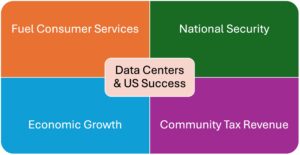
Regardless of public opinion, continued data center development is essential to the economic success of the United States. Data centers power the digital economy by supporting cloud computing, artificial intelligence, and online services such as streaming, social media, and banking. They also support critical infrastructure, including air traffic control systems and emergency services like 911. By providing massive, secure storage and processing power, data centers enable the exponential growth of data generation. As a result, they are essential infrastructure for national security, economic growth, innovation, high-tech job creation, and local tax revenue.
The United States has more than 310 million smartphone users who increasingly expect fast, reliable digital services from the comfort of their homes. From online shopping and travel planning to streaming content, emailing family members, watching youth sporting events, and paying bills, consumers demand more powerful and seamless digital experiences. Data centers are central to delivering these services, much like cellular towers were essential to mobile phone service in the 1990s. As artificial intelligence expands what technology can do, digital services will continue to grow. AI also improves customer service by providing around-the-clock access to services that were once limited to traditional business hours, while the delivery of AI-generated data and information continues to increase.
National security may be the most important long-term role of data centers in the United States. Since World War II, the U.S. has dominated the global economy and benefited from economic and political stability. Today, the rise of China and its heavy investment in manufacturing, artificial intelligence, and automation—largely powered by data centers—poses a direct challenge. The United States is now in an AI race for global leadership. Militaries are transforming their operations by shifting decision-making and battlefield capabilities from humans to machines. Conflicts such as the war in Ukraine demonstrate how emerging technologies are tested in real time. Governments rely on secure data centers to protect sensitive defense, intelligence, and critical infrastructure data from cyber threats. Data centers are now critical U.S. national security assets, housing essential defense, economic, and intelligence information. Their resilience against physical attacks, cyber threats, and foreign control has become a top policy priority, especially as AI blurs the line between civilian and military infrastructure. Disruptions to these facilities could cripple military operations, financial markets, and essential services. According to the Foreign Policy Research Institute, the Pentagon’s Joint Warfighting Cloud Capability and Joint All-Domain Command and Control networks rely on the same commercial power and server infrastructure used by industry, meaning vulnerabilities affect both sectors simultaneously.
Beyond security, data centers deliver substantial economic benefits. They attract large-scale investment, create high-paying construction and technology jobs, and generate significant tax revenue at both the local and national levels. Employment in U.S. data centers grew more than 60% between 2016 and 2023, increasing from 306,000 to 501,000 workers. Wages typically range from $50,000 to well over $100,000, making data centers a source of well-compensated employment across skill levels.
According to the Northern Virginia Technology Council and the Joint Legislative Audit and Review Commission, data center investment creates economic value in several key ways. Data centers drive GDP growth, create thousands of high-paying jobs, and spur innovation across multiple sectors. In Virginia alone, data center construction and operations generated approximately $31 billion in economic output in 2023. Large data centers can employ up to 1,500 workers during construction, many earning six-figure wages, and create more than 50 permanent operational jobs, with additional employment generated throughout the surrounding economy. Data centers also act as catalysts for related industries such as energy, telecommunications, cloud services, software, and manufacturing. In Northern Virginia’s “Data Center Alley,” rapid data center growth led to new substations, transmission lines, and real estate development. Additionally, the technological demands of data centers are driving innovation in green energy and sustainable power solutions, including solar energy, fuel cells, and small modular reactors, while modular construction methods allow for faster and more sustainable development.
Massive investment in data centers also results in significant tax revenue growth for communities. Loudoun County, Virginia—often called the “Data Center Capital of the World”—demonstrates this impact. Between 2018 and 2024, permitted data center space in the county grew from 13 million to 43 million square feet, a 231% increase. Today, data centers contribute an estimated $890 million annually in tax revenue, nearly matching the county’s $940 million operating budget. Data centers are especially cost-efficient for local governments, requiring only $0.04 in public spending for every dollar of tax revenue generated, compared to $0.25 for traditional businesses. This surplus has allowed Loudoun County to invest more than $1 billion in road improvements and build thirty-six new schools over the past 15 years while maintaining one of the lowest property tax rates in Northern Virginia.
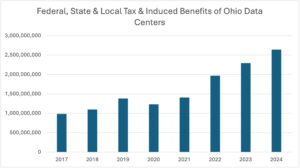
A study by the Ohio Chamber of Commerce found that data centers contributed more than $1 billion in state and local tax revenue in a single year, with total direct, indirect, and induced contributions reaching $5.2 billion since 2017.
Many states and local governments offer tax incentives to attract data centers, but these incentives often produce substantial returns. Communities benefit not only from income taxes paid by construction workers and data center employees, but also from payments made directly by data center companies. For example, a data center built on farmland that previously generated only $3,000 per year in property taxes can generate more than $1,000,000 over the life of an economic development agreement. While global manufacturing facilities may offer greater economic benefits, such projects are rare and often inaccessible to rural communities that lack the necessary workforce. In contrast, data centers offer a realistic and impactful economic opportunity for many regions across the United States.