

From a site development perspective, data centers require large footprints and massive, stable power supplies ranging from megawatts to gigawatts. These facilities need strong access to the electric grid, advanced cooling systems, high-capacity fiber connectivity, and often dedicated substations. The rise of artificial intelligence is driving demand for even larger sites and power capacities exceeding one gigawatt, placing significant strain on local power grids and land resources.
Data centers can range in size from as small as 10,000 square feet for smaller facilities to more than one million square feet for hyperscale data centers. Hyperscale facilities may occupy more than 10 acres, while large AI-driven data centers can require 500 to 800 acres to support infrastructure such as multiple substations. Data center size is often measured by electrical demand, which can range from 1 to 5 megawatts for smaller sites to over 100 megawatts for large or hyperscale facilities. Compared to typical office buildings, data centers can consume 10 to 50 times more energy per square foot, with IT equipment accounting for approximately 45 percent of total energy use. AI-driven data centers are pushing power demand beyond one gigawatt, requiring access to extremely reliable, high-capacity utility power. As a result, prime data center locations are those with direct access to on-site power generation or high-capacity power grids, multiple fiber-optic connections, and sufficient water resources for cooling.
The growth of computing power and increased data consumption generate enormous amounts of information that require centralized, secure, and reliable locations for storage and processing. Data centers serve as the physical backbone of the modern digital economy, enabling innovation, supporting essential services, and generating significant economic benefits across the United States.
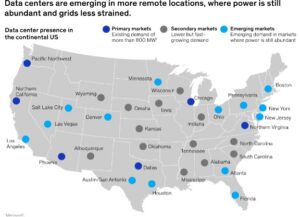
Source: McKinsey
Data center employment is heavily concentrated in certain states. California accounts for 17 percent of U.S. data center employment, followed by Texas at 10 percent. Together with Florida, New York, and Georgia, these five states represent more than 40 percent of total data center employment nationwide.
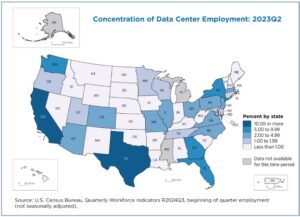
Employment concentration is uneven within states as well. In California, three counties—San Francisco, Los Angeles, and Santa Clara—account for 60 percent of the state’s data center employment. In Texas, 75 percent of employment is concentrated in Travis, Bexar, Collin, and Dallas counties. Data center employment has also doubled in states such as Arkansas and Alabama and has grown significantly in the District of Columbia, Maine, Connecticut, and Georgia.
Ultimately, data centers locate where power is available. Limited investment in electric transmission infrastructure, supply chain challenges for distribution equipment, and the transition from coal to renewable energy sources that cannot consistently meet 24/7 demand have led many data center projects to consider natural gas for on-site power generation. As a result, data centers may seek locations near large interstate natural gas transmission pipelines to generate power behind the meter.
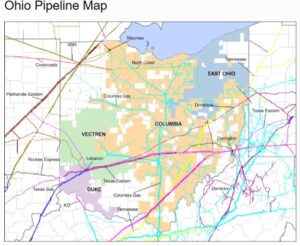
Source: Ohio Gas Association
While data centers are not suitable for every community, they can serve as a major economic asset when located in the right place.