

State Energy Policy and the Energy Industry: Navigating Transition and Investment
The energy industry remains foundational to economic vitality and competitive advantage. However, problems with the electric transmission and distribution network now threaten economic growth. Technology is evolving, resources are shifting, and climate considerations are driving policy change. As a result, state energy policy and federal regulation face unprecedented complexity. Communities weighing economic development, workforce, and infrastructure strategies need to understand both the industry and the emerging rules.
Defining the Energy Industry
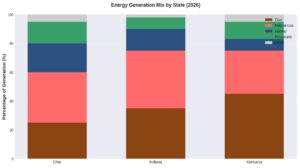 The energy industry covers the generation, transmission, distribution, and consumption of electricity and fuel. Key segments include fossil fuel production (coal, natural gas, and petroleum) and electric generation facilities (thermal, nuclear, and renewable). It also includes transmission and distribution infrastructure and retail utilities serving end customers. Finally, emerging renewable development adds wind, solar, geothermal, and battery storage. This diverse ecosystem generates massive economic value. It employs hundreds of thousands of workers and supports economic activity in every sector.
State Energy Policy Issues Facing the Industry
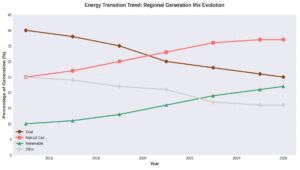
State policymakers face interconnected energy challenges. First, they must manage the transition from fossil fuels toward renewables while maintaining reliability and affordability. Second, they must adapt aging infrastructure to new demand patterns. Third, they must balance environmental protection with economic competitiveness. They also need to support workforce transitions as coal and traditional generation decline. At the same time, states want to attract AI data centers and emerging energy technology investment. In coal-dependent regions, states also navigate tension between federal climate mandates and local economic realities.
The Multi-Level Regulatory Framework
Energy regulation occurs at three levels of government. Federal agencies, including the Department of Energy and the Federal Energy Regulatory Commission, set grid reliability standards, interstate transmission rules, and national energy policy. State public utility commissions establish retail rates, approve utility investments, set renewable portfolio standards, and regulate utility conduct. Local governments manage land use, zoning for generation facilities, and community impacts. Consequently, this layered structure creates coordination challenges and competing priorities.
Energy’s Role in Economic Performance
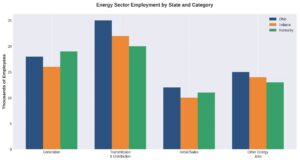 Energy costs strongly influence economic competitiveness, industrial location decisions, and household affordability. The energy sector directly employs over 700,000 Americans and supports millions more in dependent industries. Energy price volatility also affects inflation, consumer spending, and business investment. Regions with affordable, reliable energy attract industrial investment and power-hungry data centers. Conversely, rising energy costs burden consumers and reduce business competitiveness. In short, the energy transition creates both opportunity (clean energy jobs and technology investment) and disruption (coal industry decline and stranded asset risk).
Divergent State Energy Policy in Ohio, Indiana, and Kentucky
Ohio employs some of the most aggressive energy transition policies. HB 6 supported nuclear and coal while rolling back renewable portfolio standards and energy efficiency mandates. Those were controversial trade-offs that reflected competing interests. More recent legislation offered substantial incentives for electric generation facilities. However, few projects have been announced since that bill passed. In addition, the Public Utilities Commission of Ohio (PUCO) adopted a new American Electric Power tariff. It creates a new process for data centers to gain access to electricity, and it has substantially reduced the potential load from data center users.
Indiana takes a voluntary rather than mandatory approach through its Voluntary Clean Energy Portfolio Standard. The Indiana Utility Regulatory Commission oversees utilities with fewer prescriptive renewable mandates than neighboring states. Indiana favors a gradual transition that respects coal industry stakeholders while supporting natural gas expansion. This moderate stance reflects the state’s coal heritage and its manufacturing competitiveness concerns.
Kentucky faces distinctive challenges as a leading coal-producing state. Its Public Service Commission balances coal industry protection with energy transition pressure. The 2026 legislative session addressed controversial provisions affecting Kentucky energy planning. Those debates reflect tension between coal-based employment and climate and reliability expectations. Meanwhile, Kentucky utilities are shifting generation toward natural gas while managing coal plant retirements and worker transitions.
Why State Energy Policy Matters for Economic Development
These divergent approaches reflect fundamental policy choices. Ohio prioritizes competitive advantage through targeted support. Indiana emphasizes stability through gradual transition. Kentucky navigates the acute challenges of a coal-dependent economy. For economic development professionals, understanding state energy policy is critical. Energy cost, reliability, and regulatory certainty directly influence business location decisions, especially for energy-intensive industries and data centers.
Contact Tim Biggam at the Montrose Group, LLC, at tbiggam@montrosegroupllc.com if you need assistance with any lobbying matter.