

Housing supply has emerged as a foundational economic development issue. Too little housing constrains talent attraction, limits population growth, reduces business investment, and undermines regional competitiveness. This analysis examines the housing supply policy solutions being advanced in Ohio, Indiana, and Kentucky. It also outlines a comprehensive public policy agenda to address the housing shortages that are holding back regional economic vitality.
Housing as Economic Development: Why It Matters
Housing is not merely a residential amenity. It is foundational infrastructure for economic development. Businesses making location decisions prioritize access to affordable, quality housing for their workforces. Likewise, talented workers weigh housing availability and affordability when deciding where to live and work. Communities with adequate housing stock attract investment, support population growth, and expand their tax base.
Conversely, housing shortages impose severe constraints. Workers cannot afford to relocate, businesses struggle to fill positions, and regions lose ground to communities with ample housing. A lack of supply also drives up cost. For example, Ohio has nearly double Indiana’s population, yet the Hoosier State produces the same number of new residential units. The average new home in Central Ohio costs $500,000, while the average new home in Indianapolis costs $392,000.
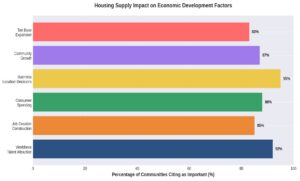
Recent research confirms housing’s economic impact spans talent attraction, construction jobs, consumer spending, and business location decisions. In other words, housing shortages translate directly into lost economic development opportunities.
Housing Supply Impact on Economic Development Factors
The Housing Supply Crisis Across the Region
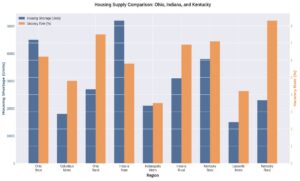
All three states face significant housing shortages in both urban and rural areas. Ohio confronts a shortage of roughly 45,000 units statewide. The Columbus metro faces acute pressure with an 18,000-unit shortfall despite rapid growth. Indiana faces an even larger statewide gap of 52,000 units, and the Indianapolis metro (21,000 units) struggles to meet workforce housing demand. Kentucky’s 38,000-unit shortage hits hardest in the Louisville metro (15,000 units). Meanwhile, rural Kentucky faces vacancy problems despite the overall shortage.
These shortages correlate with reduced affordability, lower homeownership rates, and heavier rental burdens for working families. Vacancy rates tell a more nuanced story. Urban metros show tight markets (3.5% to 4.8% vacancy), which signals insufficient supply. Rural areas, however, show higher vacancy (6.9% to 8.3%) that reflects outmigration and abandonment. Therefore, this split market requires different solutions for metro growth management and rural revitalization.
Housing Supply Comparison – States and Metro Regions
A Comprehensive Housing Supply Policy Agenda
Addressing housing supply requires a multi-faceted approach. The following policies work together:
- Streamlining zoning and permitting removes regulatory barriers to development.
- Affordable housing incentives ensure the housing supply serves diverse income levels.
- Mixed-income development strategies and funding promote inclusive communities.
- Infrastructure funding provides the water, sewer, and transportation that support new development.
- Workforce housing programs directly connect housing to economic development priorities.
- Public-private partnerships leverage private development with public investment and land. Tax credits and abatement programs incentivize development in strategic locations.
- Anti-vacancy reforms activate underutilized housing stock in communities experiencing abandonment.
States and communities should adopt these policies in sequence. First, streamline permitting. Next, advance infrastructure investment. Then establish workforce housing programs and deploy tax incentives. Anti-vacancy reforms should target rural communities with abandonment challenges. Finally, public-private partnerships multiply effectiveness by pairing public land and infrastructure with private capital.
Implementing the Housing Supply Policy Agenda
Housing supply policy is one of the highest-impact economic development investments available to state and local leaders. Ohio, Indiana, and Kentucky face significant but solvable housing challenges. Adopting the agenda above will expand supply, attract talent, support business investment, and position the region for sustained competitiveness. Specifically, that means prioritizing permitting reform, infrastructure investment, workforce housing programs, and strategic tax incentives. Communities that act decisively on housing will gain a competitive edge. In short, housing supply expansion is not merely a quality-of-life issue. It is foundational to regional economic growth and prosperity.
Contact Tim Biggam at the Montrose Group, LLC at tbiggam@montrosegroupllc.com if you need assistance with any lobbying matter.