

Rural communities across America face an existential demographic challenge. Rural population loss undermines economic vitality, shrinks tax bases, strains public services, and accelerates community decline. Ohio, Indiana, and Kentucky show the crisis clearly. Rural Ohio could lose up to 30 percent of its population by 2050, and counties such as Pike, Vinton, and Lawrence face especially steep declines. Yet this challenge can be addressed through intentional state policy. A five-point agenda that combines financial incentives, housing development, incentive restructuring, regional planning, and workforce retention offers rural communities a path to renewal and sustainable growth.
Defining the Rural Population Crisis
Rural population loss is a cascading crisis. It affects workforce availability, business investment, school capacity, and the sustainability of public services. Young adults leave for metropolitan areas in search of jobs, education, and cultural amenities. As services deteriorate, schools shrink, and business investment fades, decline accelerates. The problem is especially acute in Appalachian and post-industrial counties. There, legacy economic bases have eroded while new opportunities remain limited.
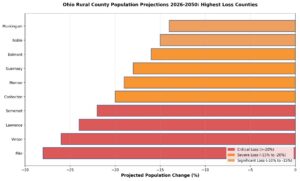
State projections show the severity. Ohio’s 2050 projections reveal catastrophic losses in rural counties. Pike County faces a 28 percent decline, Vinton County 26 percent, Lawrence County 24 percent, and Somerset County 22 percent. These numbers mean thousands of lost residents, reduced economic activity, and diminished regional influence. Kentucky and Indiana rural counties face similar trajectories. Therefore, policy intervention is urgent.
Ohio Rural County Population Projections to 2050
A Five-Point Policy Agenda to Reverse Rural Population Loss
Reversing rural population loss requires multi-faceted state policy. Evidence from state programs and federal initiatives shows that coordinated action produces measurable retention and growth. The five-point agenda below gives state leaders proven tools for population stabilization and economic renewal.
Point One: Baby Bonus and Childcare Investment Programs
Baby bonus and childcare programs create direct financial incentives for young families to stay in or move to rural communities. The Bipartisan Baby Bonus Act (H.R. 6234) proposes federal tax benefits for newborns. States with parallel programs have documented strong retention effects. Accordingly, states should adopt their own baby bonus programs. These would provide $3,000 to $5,000 in tax credits or direct payments for each child born and remaining in designated rural counties. Bundled childcare investments, such as subsidized daycare, preschool support, and family leave, make the program more effective. They remove barriers to workforce participation for young parents.
Point Two: Rural Housing Development and Land Acquisition Programs
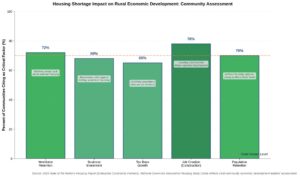
Rural housing programs address the shortage that limits population growth. Kansas’s Reinvestment Housing Incentive District (RHID) program is a model for aggressive state intervention. It provides dedicated state funding for rural land acquisition, housing development financing, and renovation incentives for owner-occupied homes. USDA Rural Housing Service programs should be leveraged alongside state funding. Specifically, states should commit $500 million annually to rural housing development. Priority should go to first-time homebuyers aged 25 to 40 and families relocating from urban areas. Above all, these programs should emphasize quality, affordable housing that supports workforce family formation.
Point Three: Economic Development Incentive Restructuring
Incentive restructuring redirects state programs toward rural investment. Currently, most state incentives concentrate in metropolitan areas and chase major corporate relocations and expansions. Instead, states should redirect 30 to 40 percent of incentive funding toward rural business development. That includes small business tax credits, entrepreneurship support, technology infrastructure, and targeted industry clusters such as agricultural technology, healthcare, advanced manufacturing, and tourism. Kentucky’s Rural Opportunity Zones and Ohio’s Appalachian regional programs offer models for geographic targeting.
Point Four: Comprehensive Rural Regional Planning Programs
Regional planning programs create coordinated frameworks that address population retention holistically. State-directed initiatives should bring rural communities together around shared economic development, workforce, housing, and infrastructure strategies. For example, the $50 billion Rural Health Transformation Program shows how federal-state partnership can address rural infrastructure, service delivery, and economic development at once. States should also establish rural development authorities that provide technical assistance, infrastructure planning, and investment coordination.
Point Five: Workforce Retention and Development Programs
Workforce programs connect the fight against rural population loss to jobs and skills. State investment in rural community colleges, apprenticeships, and vocational training creates career pathways that keep young workers home. Remote work infrastructure, including broadband, co-working spaces, and digital literacy programs, lets rural residents access metropolitan-level jobs without leaving. In addition, employer incentives for rural locations and workforce development partnerships multiply the effect.
State Implementation Examples and Policy Models
Regional states are pursuing different strategies against rural population loss. Ohio should build on its Appalachian programs while creating new rural housing funds targeting Pike, Vinton, and Lawrence counties. Recent Ohio legislation on workforce development and infrastructure provides a foundation for an expanded rural focus. Indiana’s cautious approach should accelerate toward specific retention initiatives, potentially through expanded USDA Rural Business Development Grants and state matching funds.
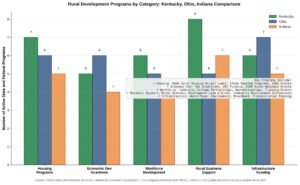
Kentucky, as a leading rural state, should establish a comprehensive Rural Population and Economic Revitalization Initiative that combines all five components. That initiative would include a state baby bonus of $2,500 per child for families remaining in designated rural counties. It would add a rural housing fund of $100 million annually and redirect 40% of state incentives to rural communities. Finally, it would create rural regional planning authorities and workforce partnerships with community colleges and employers. Georgia’s rural development initiatives and Montana’s incentive programs provide implementation models.
Other states offer proven examples as well. Missouri provides rural workforce tax credits for employers in designated counties. Mississippi offers rural real estate tax abatements, Arkansas provides rural manufacturing incentives, and North Carolina funds rural community development grants. Federal programs, including USDA Community Development Block Grants, Rural Infrastructure Investment Programs, and Economic Development Administration funding, should be pursued aggressively and matched with state dollars.
Rural Population Loss Is Reversible
Rural population retention is among the highest-impact economic development investments available to state leaders. Implementing all five components produces measurable population stabilization, business investment, and growth. Ohio, Indiana, and Kentucky face critical population trajectories. However, aggressive state action can reverse those trends and position rural communities for lasting prosperity.
Effective implementation requires a sustained multiyear commitment and adequate funding of $100 to $150 million annually per state. It also requires coordinated agency action and private sector partnership. States should establish rural development authorities to provide technical assistance and investment oversight. Regional coordination across the three states amplifies impact and creates an advantage in attracting employers and families seeking rural opportunity.
Communities and states that act on rural population loss will capture substantial benefits: stable tax bases, expanded workforce availability, business investment, and regional growth. Rural renewal is achievable through intentional policy leadership. The five-point agenda provides a proven roadmap for state action.
Contact Tim Biggam at the Montrose Group, LLC at tbiggam@montrosegroupllc.com if you need assistance with any lobbying matter.