

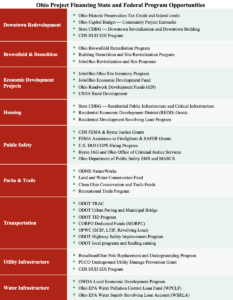
Every capital project has a funding source. The challenge is knowing which one, when it opens, and what it takes to win. That is where an Ohio project financing strategy begins. Montrose Group screens public and private priority projects against more than 40 state and federal programs. As a result, that inventory offers a useful map for any organization planning a project. The programs sort into four quadrants: state and federal, public and private.
Ohio Project Financing for Local Governments
For local governments, the state side starts with the Ohio Capital Budget. Here, lawmakers award community project earmarks legislatively rather than competitively. Consequently, winning them requires a multi-year relationship with House and Senate members.
Roads, Water, and Sewer
The Ohio Public Works Commission funds roads, bridges, water, sewer, and stormwater. It does so through its State Capital Improvement and Local Transportation Improvement programs. In addition, the Ohio Water Development Authority finances treatment plants and lines at below-market rates. Ohio EPA’s Water Pollution Control and Water Supply revolving loan funds do the same. Meanwhile, ODOT’s TRAC, Municipal Bridge, and Transportation Improvement District programs carry larger roadway projects.
Parks, Public Safety, and Community Facilities
Parks and trails draw on ODNR NatureWorks, Clean Ohio, the Land and Water Conservation Fund, and the Recreational Trails Program. For police, fire, and EMS, key sources include Byrne JAG and COPS Hiring. FEMA’s SAFER and Assistance to Firefighters grants also help, along with Ohio’s MARCS and EMS grants. At the federal level, Congressionally Directed Spending, HUD’s Economic Development Initiative, and USDA Rural Development fund community facilities directly.
Ohio Project Financing for Private Developers and Employers
Private developers and employers work with a different set of tools. The All Ohio Future Fund is the headline. In July 2025, the state awarded more than $225 million to four sites:
- $78.75 million for Dayton International Airport
- $67.4 million for Lorain County water capacity
- $58.75 million for Coshocton County’s Conesville Industrial Park
- $20.7 million for Zanesville-Muskingum
Those awards brought the program to $350 million across 11 sites. Notably, Montrose advocated for both the Dayton and Coshocton awards. In addition, JobsOhio’s Site Inventory and Economic Development Fund programs support job-creating projects. Roadwork Development (629) funds also help by extending utilities and roads to the property line.
Tax Credits and Brownfield Grants Drive Redevelopment
Redevelopment relies on tax credits and remediation grants. For example, the Transformational Mixed-Use Development credit and the Ohio Historic Preservation Tax Credit delivered $14 million and $12.9 million, respectively, in June 2026. Those awards went to Northeast Ohio projects alone. These state credits pair with the federal historic credit and New Markets Tax Credits. Together, they close financing gaps on catalytic buildings.
Brownfield funding is just as important. Ohio’s Brownfield Remediation Program has distributed more than $490 million to 462 projects in 84 counties. Its companion, the Building Demolition and Site Revitalization Program, has invested more than $270 million in over 5,000 demolitions. As a result, these programs clear sites that private capital would never touch on its own.
Layering Sources Is the Key to Ohio Project Financing
The common thread is that no single program finances a project. Instead, winning projects layer several sources:
- A competitive grant
- A subsidized loan
- A legislative earmark
- A tax credit
- A local tool such as TIF, a JEDD, or a Transportation Improvement District
That way, no project depends on one uncertain award. This Ohio project financing strategy is what Montrose brings to communities and companies alike. It starts with a capital project inventory, a project-by-source alignment matrix, and a rolling funding calendar. Together, these tools put the right project in front of the right program at the right time.
Contact Dave Robinson at drobinson@montrosegroupllc.com or 614-738-2109 to map funding sources for your project.