

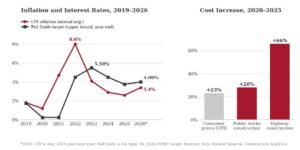
The era of cheap money is ending, and that makes Ohio infrastructure funding more important than ever. The US-Iran war is driving up costs and inflation for a wide range of goods and services. Construction costs, in particular, are going through the roof. As a result, the Federal Reserve has raised interest rates to stem inflation, which hurts private developers’ bottom lines. Meanwhile, work from home and AI are changing where people work and which jobs will exist in five years. All of this affects how local governments collect tax revenue.
Ohio Communities Are Outgrowing Their Tax Bases
Many communities are growing faster than their tax bases. For example, Marysville, one of Central Ohio’s fastest-growing cities, has added one-fifth of its population since the 2020 Census. Similarly, Union County grew from 62,784 residents in 2020 to an estimated 73,446 in 2025.
However, growth of that size arrives before the infrastructure does. New residents expect water lines, treatment capacity, roads, police and fire response, parks, and civic amenities on day one. Local revenue alone cannot close a capital gap this large. Otherwise, communities face rate shock for existing residents or must delay the projects that make growth possible. Therefore, the answer for Marysville, and for hundreds of Ohio communities facing the same math, is a disciplined pursuit of Ohio infrastructure funding from state and federal sources.
Ohio Infrastructure Funding Is Flowing in 2026
The good news is that the dollars are real. Governor DeWine signed a $3.7 billion state capital budget on June 15, 2026. It includes roughly $208 million for local community projects statewide.
Two weeks later, the Ohio Public Works Commission (OPWC) released $392.8 million for 678 local infrastructure projects. These projects span 87 of Ohio’s 88 counties. The funding breaks down as follows:
- Roads: $256.4 million
- Water supply: $64.1 million
- Wastewater: $35.4 million
- Bridges and culverts: $23.5 million
- Stormwater: $13.4 million
In addition, the Small Government Program delivered $37.4 million to 89 projects in villages and townships with fewer than 5,000 residents.
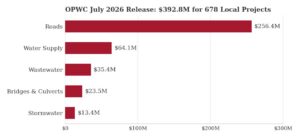
Figure 1. OPWC’s July 2026 release by infrastructure category. Source: Ohio Public Works Commission.
Federal Dollars Fill the Gaps
Washington matters too. Ohio’s congressional delegation secured more than $31 million in Congressionally Directed Spending in the FY 2026 funding package Congress finalized in January. That money funds a Wooster roundabout, a Chillicothe park, and a Youngstown airport runway, among other projects.
Federal programs also play a major role. These include FEMA’s SAFER and Assistance to Firefighters grants, USDA Rural Development, the Land and Water Conservation Fund, and HUD’s Economic Development Initiative.
Every Ohio Need Has an Infrastructure Funding Source
The lesson is simple: Ohio infrastructure funding exists for nearly every local need. For instance:
- Parks and trails: ODNR NatureWorks, Clean Ohio, and the Recreational Trails Program
- Water and sewer: OWDA, Ohio EPA’s revolving loan funds, and OPWC
- Roads and bridges: ODOT TRAC, Municipal Bridge, Transportation Improvement Districts, and MORPC’s dedicated funds
- Public safety: Byrne JAG, COPS Hiring, and Ohio’s MARCS and EMS grants
- Site development: the All Ohio Future Fund, JobsOhio Site Inventory, and Roadwork Development (629) funds
A Proven Track Record
Montrose Group’s track record shows that this model works. For example, the firm advocated for a $78 million All Ohio Future Fund award for site development at the Dayton Airport. It also advocated for $58 million for Coshocton County, plus $7 million in state jail funding for the county. Other wins include $6 million for Madison County public safety and community projects. Similarly, Montrose advocated for $5 million each for the Newark Arcade and the Columbus Association for the Performing Arts. Finally, the firm helped win capital budget park funding for Piqua and Sunbury.
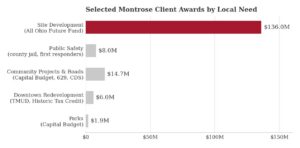
Figure 2. Selected Montrose Group client awards grouped by the local need they served.
Strategy, Not a Lottery Ticket
However, winning these dollars takes more than an application. First, a community needs a capital project inventory and a project-by-source alignment matrix. Next, it needs a rolling 24-month funding calendar and early engagement with program officers. Finally, it needs a multi-year advocacy presence at the Statehouse and in Washington. In short, communities that treat grant writing and advocacy as a strategy, not a lottery ticket, build parks, pipes, and roads on the same schedule as their growth.
Contact Dave Robinson at drobinson@montrosegroupllc.com or 614-738-2109 to discuss project financing for your community.