

Ask a site selection consultant what kills a project in due diligence, and you will hear the same answer: the labor math does not work. A 300-job plant in a county of 30,000 does not fail because the site lacked water pressure. It fails because three hundred households have nowhere to live within a reasonable commute — and no builder will construct at a price those wages support. A housing study is how a community learns that answer before the consultant does.
Housing has quietly become a site location criterion. Companies now ask about unit availability by price point, rental vacancy, and permit activity in the same breath as electric capacity. Communities that cannot answer get eliminated quietly and never learn why.
Why the Housing Study Comes First
Every community says it needs housing. However, almost none can say how many units, of what type, at what price, for which wage bands. That difference matters, because incentives, zoning changes, and infrastructure dollars are all sized off those numbers. A housing study converts a shared complaint into a financeable demand forecast. Just as importantly, it gives developers the third-party evidence their lenders require before building speculatively in a small market.
Critical Elements of a Housing Study
Housing studies are deep data dives that send critical signals about what type of housing can succeed in a market:
- Demand forecast by price point and product type — units needed, segmented by owner and renter and by income band
- Employment and wage projections — housing demand is downstream of payroll
- Existing inventory analysis — units by type, age, condition, tenure, and vacancy
- Affordability gap — sale prices and rents mapped against local incomes
- Absorption and permit trends — what the market has delivered, not what it says it wants
- Commuting patterns — how many daily in-commuters could become residents
- Development capacity — buildable land, zoning, sewer and water capacity, and platted lot inventory
- The construction cost versus appraisal gap — in rural markets, the decisive constraint
- Builder and lender interviews — the reality check on all the above
- An action plan with named financing tools and adopting bodies
What Gallia County Found
The Montrose Group’s 2024 housing study for this Ohio River county produced a specific, four-part demand profile rather than a general call for housing: significant growth in multi-family product including apartments, townhomes, and condominiums; single-family homes in dense subdivisions; infill units on existing lots; and renovation of existing stock. Projected job growth is driving that demand — a minimum of 3,470 new permanent jobs are expected in the region.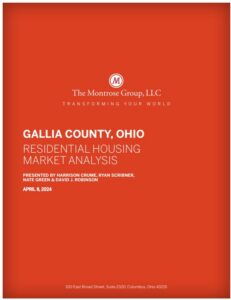
The value showed up in what happened next. Gallia County established a Community Reinvestment Area in 2024 and expressly built it to incentivize the development types the study identified — residential abatements alongside commercial and industrial, keyed to the documented need. The study did not sit on a shelf. It became the eligibility criteria.
That is the point of a housing study: not to describe a problem, but to define exactly what gets built — and to give the county a defensible reason to pay for part of it. After all, a home is where a job sleeps.
The Montrose Group has completed over sixty economic development plans for public and private sector clients. Contact Dave Robinson at drobinson@montrosegroupllc.com if you need assistance with any economic development plan.