

A Montrose Group Economic Development Analysis
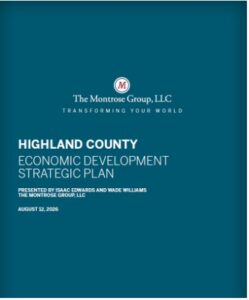
Companies are reassessing their operational footprints. They want communities that offer value, stability, and room to grow. Highland County economic development checks all three boxes. The Montrose Group completed the county’s Economic Development Strategic Plan in 2026. That plan documents why this south-central Ohio county is an attractive destination for companies that want to establish, expand, or relocate operations.
A Growing, Stable Community
Highland County’s demographic profile shows the fundamentals that matter to employers: population stability plus growth momentum. The county has 43,785 residents. Its population has held steady for two decades, and it posted gains from 2020 through 2024. In other words, the community is gaining confidence and attracting new residents. Both trends are positive signs for workforce availability and consumer demand.
The county’s income profile shows a strong middle-income concentration. For example, 34.55% of households fall in the $25,000 to $34,999 range, which exceeds Ohio’s state average for that bracket. Median household income is $62,008, and mean income is $76,105. As a result, Highland County offers reasonable cost structures and solid purchasing power. For companies, that means predictable market conditions and a workforce ready to earn higher wages through quality jobs.
An Educated, Available Workforce
The workforce is Highland County’s most valuable asset for business investment. About 86.9% of residents hold a high school diploma, which approaches Ohio’s 92.2% statewide rate. Therefore, the county has the educational foundation for manufacturing, healthcare, professional services, and technical roles.
More importantly, the strategic plan stresses workforce system development and talent retention. That focus signals a commitment to continuous skill-building aligned with employer needs. Rather than competing for scarce talent in crowded urban markets, employers in Highland County gain access to an education-ready population with manageable costs. For companies that want reliable, stable workers committed to long-term employment, this is a real competitive advantage.
Housing: An Underutilized Asset for Highland County Economic Development
Housing availability often limits corporate relocation and expansion. Highland County’s strategic plan targets 500 new residential units and 200 acres of residential development. These are concrete commitments to workforce housing alongside economic development.
This proactive approach addresses a basic business need. Employers can only attract and retain talent when affordable, quality housing exists. In addition, real estate costs are reasonable compared to larger Ohio metros. Consequently, companies can offer competitive compensation while protecting their margins. As employers add jobs, housing capacity expands with them. That removes the workforce constraint that has slowed growth in other communities.
Economic Investment Opportunity
The county’s economic profile reflects realistic opportunity. The strategic plan commits $5 million over five years to economic development infrastructure. Specifically, it directs funding to industrial site preparation (750 acres), workforce development, and community enhancement. This investment shows serious, sustained commitment from local leaders. It also proves the county has resources available for business partnerships.
The plan targets 500 net new quality jobs over five years, with an emphasis on higher wages. In short, Highland County economic development pursues quality over volume. The county seeks employers that create lasting prosperity for residents while building long-term community wealth.
Why Consider Highland County Now?
For companies evaluating locations, Highland County offers an unusual combination. It has a stable, educated workforce and affordable real estate and construction costs. It has development-ready industrial acreage and planned housing for employee attraction. Above all, it has committed local leadership with dedicated resources for business partnership.
The community is neither underdeveloped nor saturated. Instead, it sits in the emerging opportunity zone where strategic investment and smart business decisions compound. The Montrose Group’s Highland County economic development plan provides the roadmap, and the opportunity is documented. The only question is whether your company is ready to invest in a community positioned for meaningful growth.
Contact Matt McCollister of the Montrose Group at mmcollister@montrosegroupllc.com if you are interested in discussing how an economic development plan can improve your community or property.