

Economic development is won or lost long before a company ever tours a site. The states that consistently land transformational projects are not simply the ones with the lowest taxes or the largest incentive checks. Instead, they are the ones whose communities did the unglamorous work of planning years in advance. That work — comprehensive plans, economic development strategies, land use plans, site due diligence — rarely makes headlines. Moreover, it is precisely the work local governments are least able to fund on their own. This is why state planning grants matter. The case rests on three realities.
First, planning is the cheapest dollar in the economic development toolkit, and it carries the highest multiplier. A $40,000 economic development plan or a $90,000 site due diligence study costs a fraction of the infrastructure grant that follows. Yet none of those larger investments can be deployed intelligently without it.
Second, planning solves a capacity problem that neither markets nor localities can solve alone. Rural counties and small towns rarely employ a professional planner or hold $50,000 in discretionary cash. Left alone, they fall behind better-staffed metros. State planning grants level that field. As one Indiana official put it, planning grants are often the first step in a community’s redevelopment efforts.
Third, speed-to-market now decides site selection. Location decisions that once took eighteen months now close in ninety days. A site that is already planned, entitled, and vetted can say yes immediately. A site that is not is simply passed over.
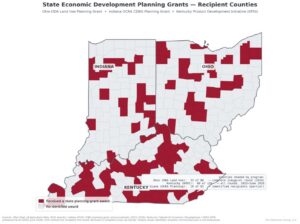
The Three Programs at a Glance
| Program | Administered by | Annual scale | What it funds | Local match |
|---|---|---|---|---|
| Ohio ODA Land Use Planning Grant | Ohio Dept. of Agriculture, Farmland Preservation Office | $1M (2026 inaugural round) | County comprehensive land use and farmland preservation plans | None required |
| Indiana OCRA CDBG Planning Grant | Indiana Office of Community & Rural Affairs (HUD CDBG) | ~$1M/year, quarterly rounds | Comprehensive, economic development, downtown, broadband, utility, and feasibility plans | 8% |
| Kentucky KPDI | KY Cabinet for Economic Development + KAED | $35M/fiscal year | Site due diligence, land acquisition, infrastructure, build-ready pads, spec buildings | 50% |
Ohio: Department of Agriculture Land Use Planning Grant
Created in the state operating budget signed June 30, 2025, this grant helps counties develop, update, or implement a Comprehensive Land Use Plan or Farmland Preservation Plan. Its purpose is to protect agricultural land, support rural economic vitality, and guide sustainable land use as Ohio grows. The inaugural round, announced May 11, 2026, distributed $1 million to twenty-two counties in awards of $25,000 to $50,000. To qualify, a county must show collaboration with every township, village, and municipality containing active farmland. Applications for the current cycle are due February 27, 2026, to farmlandpres@agri.ohio.gov.
Indiana: OCRA CDBG Planning Grant
Funded through the federal Community Development Block Grant program, this grant awards $1 million per year in small quarterly batches to non-entitlement counties, cities, and towns. It funds named plan types: Comprehensive Plans ($50,000–$60,000), Economic Development Plans ($40,000), Downtown Revitalization Plans ($30,000–$40,000), Broadband Readiness Plans ($50,000–$70,000), Utility Studies ($30,000–$90,000), and Feasibility plans ($20,000). The local match is just 8%. Applications must be filed by an OCRA-certified grant administrator with professional services procured beforehand.
Kentucky: Product Development Initiative (KPDI)
KPDI commits $35 million per fiscal year — with up to $220 million allocated to date — to prepare industrial sites and buildings. All 120 Kentucky counties are eligible for a population-based maximum with a dollar-for-dollar match. Uniquely, KPDI funds site due diligence as a standalone category. The results are substantial: the 2022 program alone approved one hundred projects generating over $516 million in combined investment. To date, fifty-one companies have located on PDI- and KPDI-funded sites, representing $5.7 billion in capital investment and over 7,400 jobs.
Case Studies: From Plan to Project
Kentucky — Pratt Industries, Henderson County
A site along Kentucky Highway 425 received funding in the first PDI round in 2019. That investment prepared the site and made it marketable. In July 2021, Pratt Industries selected it for a 100%-recycled paper mill and box factory. The company broke ground in December 2021 and opened in September 2023. Final investment reached approximately $700 million across 1.1 million square feet, creating 320 to 325 jobs at an average wage near $100,000. The causation is direct: the grant readied the land, and the company located there because it was ready.
Indiana — Town of Whiteland, Johnson County
In December 2023, Whiteland (population 4,400) received a $50,000 OCRA Comprehensive Planning Grant — its first plan update since 2011 — with adoption in March 2025. The timing was no accident. Whiteland had become one of central Indiana’s hottest logistics corridors, home to the 475-acre Mohr Logistics Park and a million-square-foot Cooper Tire distribution center. Here, the grant’s role is to govern and capture transformative growth. The plan is the instrument Whiteland uses to shape that buildout and stay fundable for the infrastructure the next phases will require.
Ohio — Fayette County
Ohio’s program requires candor. Because it made its first awards only in May 2026, no completed plan-to-project case exists yet. However, the recipient list is telling. Fayette County, one of the 22 grantees, is home to the Honda–LG Energy Solution battery plant — a $3.5 billion commitment rising toward $4.4 billion, employing 2,200 workers on former farmland. Licking County, another grantee, is absorbing Intel and a wave of data centers on similar ground. These farmland-consuming successes are exactly what prompted counties to pursue land use plans: to decide deliberately where growth belongs and which agricultural land to protect. That is the program working as designed.
The Montrose Group has completed over sixty economic development plans for public and private sector clients. Contact Dave Robinson at drobinson@montrosegroupllc.com if you need assistance with any economic development plan.