

The U.S. Aerospace and Defense (A&D) sector is one of America’s most strategically critical industries — powering national defense, advanced manufacturing, and technological innovation. To identify where this industry is strongest, Montrose Group and Malone Workforce Solutions partnered to develop the Aerospace and Defense Metro Competitiveness Index, evaluating 43 metropolitan areas across the country.
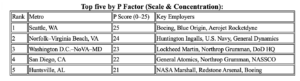
The analysis identified five regions that rose above all others: Seattle, Norfolk-Virginia Beach, Washington D.C., San Diego, and Huntsville, Alabama.
How the A&D Metro Competitiveness Index Works
Montrose Group and Malone Workforce Solutions built the index around a proprietary P–Q–R–S Framework, scoring each metro on a 1–5 scale (5 = World-Class, 1 = Emerging) across four dimensions:
P – Scale and Concentration: Total A&D employment and industrial density measured relative to national leaders, including total employment, location quotient, and major firm count.
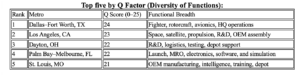
Q – Diversity of Functions: The presence of multiple A&D value-chain segments — OEMs, suppliers, R&D, MRO, and depots — capturing industry resilience through a count of distinct subsectors and facility mix.
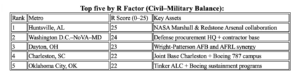
R – Civil-Military Balance: The degree of integration between private industry and federal and military installations, rewarding regions that leverage bases and research labs for commercial innovation through a military-to-private employment ratio and public-private co-location index.
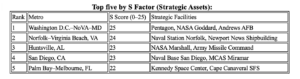
S – Strategic Asset Quality: The presence of nationally significant infrastructure and institutional assets — including R&D centers, test ranges, and launch facilities — that quantify long-term competitiveness.
The Top 5 Aerospace and Defense Regions in the United States
The five highest-scoring metros collectively employ more than 400,000 A&D workers, representing 40% of the national total.
- Seattle, Washington — The national leader in A&D employment density and OEM concentration
- Norfolk-Virginia Beach, Virginia — A dominant civil-military hub anchored by one of the largest naval installations in the world
- Washington D.C. — The epicenter of federal defense procurement, R&D investment, and defense contracting
- San Diego, California — A full-lifecycle A&D region with deep integration between the Navy, private contractors, and research institutions
- Huntsville, Alabama — The fastest-rising defense corridor in the South, anchored by Redstone Arsenal and a rapidly growing OEM and R&D ecosystem
Key Findings from the Competitiveness Index
Full Lifecycle Regions Lead in Resilience: Regions with end-to-end capabilities spanning R&D, manufacturing, MRO, and logistics demonstrated the highest resilience scores. Dallas-Fort Worth, Los Angeles, Dayton, and St. Louis lead in cross-functional balance.
Civil-Military Integration Drives Sustainability: Metros with strong public-private coordination — including Albuquerque, Oklahoma City, and Charleston — rank highly due to combined defense installations and private-sector partnerships.
Infrastructure Differentiates Long-Term Competitiveness: NASA centers, Air Logistics Complexes, launch pads, and advanced test facilities set nationally significant metros apart from emerging competitors. Communities investing in multimodal access, site readiness, and utilities are gaining long-term positioning advantages.
Strategic Takeaways for the U.S. Defense Industrial Base
The Montrose Group 2025 A&D Metro Competitiveness Index confirms a structural transformation underway in the U.S. defense industrial base. Key findings include:
- Distributed leadership — National competitiveness now relies on an interlinked system of production, research, and sustainment hubs rather than a few coastal concentrations
- R&D integration — Federal labs including AFRL, Sandia, NASA, and DOE remain critical to next-generation systems; metros co-locating R&D and OEMs consistently outperform others
- Supply chain modernization — Onshoring and additive manufacturing favor regions with industrial flexibility, including Tulsa, Wichita, and Indianapolis
- Infrastructure readiness — Investment in multimodal access, site readiness, and utilities delivers long-term competitive positioning
- Public-private coordination — The strongest markets exhibit deep collaboration among base leadership, universities, OEMs, and local development authorities
What’s Next for U.S. Aerospace and Defense Investment
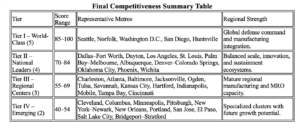
Montrose Group anticipates sustained federal investment and private-sector expansion across Tier II and Tier III regions — particularly those emphasizing workforce alignment, infrastructure, and innovation ecosystems. Metros scoring four or higher on the competitiveness index represent the foundation of America’s defense industrial capacity and are best positioned to capture the next decade of aerospace and national security investment.
Please contact Wade Williams at wwilliams@montrosegroupllc.com if you need assistance with an A&D or other corporate site location or want to make your region more competitive for high growth industries.