

The aerospace and defense (A&D) industry is one of the most powerful economic forces in the United States. From military aircraft and commercial aviation to satellites and autonomous systems, this sector drives innovation, employment, and national security at an unprecedented scale.
What Is the Aerospace and Defense Industry?
The aerospace and defense industry includes companies that manufacture and support products for military and aviation use. This covers:
- Military vessels including submarines, destroyers, and aircraft carriers
- Military and commercial aircraft including bombers, fighter jets, and passenger planes
- Weaponry such as missiles and ammunition
- Defense technology including radar, sonar, and satellites
- Spacecraft for government space programs and commercial space tourism
The Scale of the U.S. Aerospace and Defense Market
The U.S. A&D industry is a cornerstone of the national economy. In 2025, the industry generated $995 billion in revenue, contributing 1.5% to national GDP and supporting a trade surplus of over $73 billion. By mid-2026, the global market is projected to reach approximately $1.05 trillion, with the United States maintaining its position as the dominant global hub.
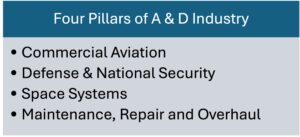
The Four Primary Segments of the Industry
Commercial Aviation: The largest revenue driver in the sector, commercial aviation focuses on passenger and cargo transport. Entering 2026, demand is at an all-time high — yet a backlog of over 14,000 aircraft, representing nearly a decade of production, still needs to be filled.
Defense and National Security: The largest direct employer in the industry, making up 54% of the total workforce. This segment covers everything from next-generation fighter jets to the Defense Industrial Base (DIB), which supplies the materials and services essential to military readiness.
Space Systems: The fastest-growing subsector. The space economy reached $613 billion in 2024 and is projected to triple by 2034. In 2026, growth is driven by low-Earth orbit (LEO) satellite constellations and a launch to orbit occurring every 28 hours.
Maintenance, Repair, and Overhaul (MRO): A critical aftermarket segment valued at over $119 billion. MRO ensures the longevity of existing fleets while airlines and operators await delayed new-model deliveries.
Jobs and Workforce Impact
The aerospace and defense industry supports over 2.2 million jobs across every U.S. state. These are high-skill, high-wage positions — average labor income reaches $112,000 annually, 50% above the national average. Small and medium-sized businesses form the backbone of the supply chain, accounting for 60% of total industry employment.
The Rise of AI and Autonomous Systems
The defining trend of 2026 is the rapid integration of agentic AI and autonomous technology into aerospace and defense. U.S. A&D spending on AI is expected to reach $5.8 billion by 2029, as companies adopt predictive maintenance tools and swarm drone technology across their core operations. The industry is no longer defined by building bigger and faster — it is defined by its digital and orbital scope.