

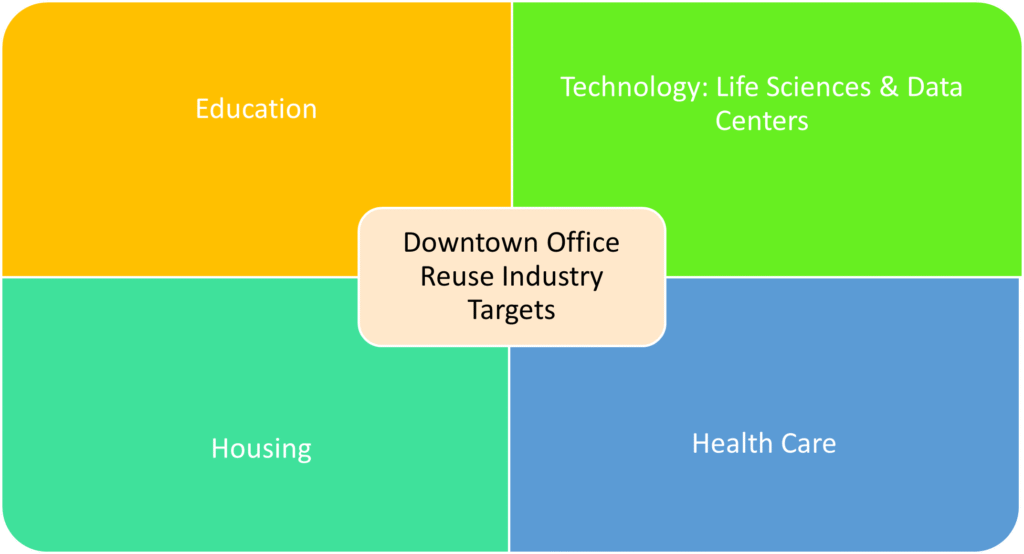
Office projects for targeted industries are likely to be a hot topic in 2025 as these uses change from previous years. Work-from home and AI deplete office buildings and drive down rents which create new opportunities for a new array of office uses. Many of these uses will be in industries needed to create a neighborhood for expanding to follow office conversion to residential projects and emerging industries like life science projects.
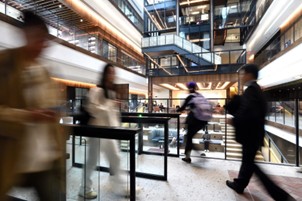
Educational Centers. The location of schools is an essential aspect of any neighborhood’s development. The reuse of existing office towers to include the development of schools is an interesting idea. In Washington D.C., which has a glut of empty office space, on Pennsylvania Avenue, in the building that used to house the Newseum, the 10-story, $650 million Johns Hopkins University Bloomberg Center has just opened in Washington.[i] The Johns Hopkins University Bloomberg Center will be anchored by the Baltimore-based world-class university and house the university’s School of Advanced International Studies, Carey Business School, the Krieger School of Arts and Sciences, Peabody Institute, and the newly established School of Government and Policy.[ii] The Hopkins Bloomberg Center will host programming from all corners of Johns Hopkins, bringing experts, students, and researchers from all the university’s Baltimore- and D.C.-based divisions together on one of America’s iconic avenues.[iii] Johns Hopkins is not alone. Dozens of institutions of higher education across the United States have bought office buildings since 2018, including forty-nine four-year private schools and sixteen four-year public institutions, according to data from JLL including UCLA which bought an Art Deco landmark in downtown Los Angeles.[iv]
Health Care Centers. Healthcare is big business globally and across the United States.
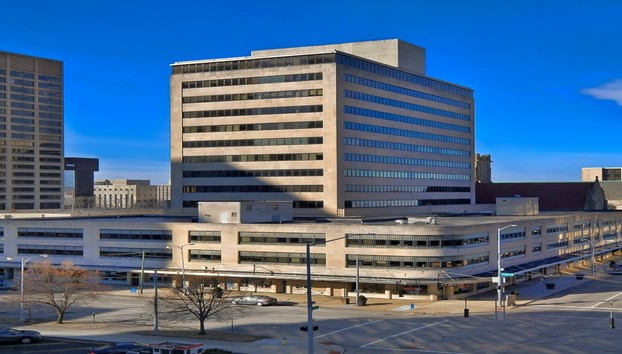
Recently, Gem City Primary Care, a family-owned practice, hosted a ribbon cutting Thursday inside its over 5,000-square-foot space on the eighth floor of Talbott Tower at 118 W First Street in Downtown Dayton becoming the first primary care practice downtown. [v] As the Baby Boomer generation ages, they are prime targets for the next generation of urban living in Downtown office markets. Eighty percent of healthcare spending is done by 20% of the population who is older provides a clear sign that healthcare institutions should be strong targets to follow their retiring customers moving into Downtown. Parking and access to these healthcare facilities will be critical but the health care industry should be a prime target for Downtown office reuse.
Technology Centers. High-tech industries such as life-sciences are another strong target for office conversion projects. The life sciences industry comprises companies operating in the research, development, and manufacturing of pharmaceuticals, biotechnology-based food and medicines, medical devices, biomedical technologies, nutraceuticals, cosmeceuticals, food processing, and other products that improve the lives of organisms.[vi] Pharmaceutical companies develop and distribute medicines to cure, treat or prevent diseases and conditions. Pharmaceutical companies may produce generic or innovator medications, and the impact of COVID on an already growing pharmaceutical industry is substantial.[vii] Biotech firms use the natural processes of living organisms to manufacture products, food and medicinal products or solve challenges, and the global biotechnology market size is expected to be worth $727.1 billion by 2025.[viii] Transitioning office towers into life sciences lab space is a process that requires investment. Life science office conversion projects require an examination of the feasibility of the existing facility that reviews floor-to-floor/ceiling height, load capacity, structural design, mechanical and plumbing systems, and fire and safety conditions is essential for the project’s success.[ix] Downtown tower office conversion to life science lab space needs to take into consideration structural requirements, building infrastructure, elevator specifications, mechanical, electric, and plumbing issues, HVCA issues, and fire, egress, and safety requirements.[x]
Data Centers. Data centers could be an adaptive reuse for empty Downtown office buildings. According to P&S Intelligence, the data center market size stood at USD 263.34 billion in 2022, and it is expected to advance at a compound annual growth rate of 10.9% during 2022–2030, to reach USD 602.76 billion by 2030 driven in larger part from the expansion of AI applications. Research indicates that data center buildings will reach 20.07 million square feet and a construction market size of approximately $25 billion by 2027 in the United States alone.[xi] Data centers are locating in Downtown office markets. The IMD1 MetroEdge Data Center will be a five-story high-rise data center located in the West Side of Chicago in a medical district targeted for transformation. The 16-megawatt facility will support the technology needs of local organizations including healthcare, financial, educational, and government institutions, and is a key component of the region’s plans to revitalize the area. Metro Edge Development Partners’ flagship data center is IMD1 in the Illinois Medical District, one of the largest urban medical campuses in the United States. The IMD brings together an ecosystem of enterprises that have inspired medical breakthroughs for over 70 years. Spanning 560 acres, the IMD is an established hub of healthcare, medical research facilities, and biotech incubators, with easy access to O’Hare International Airport, public transportation, major expressways, commuter rails, and all less than two miles from Chicago’s Central Business District.
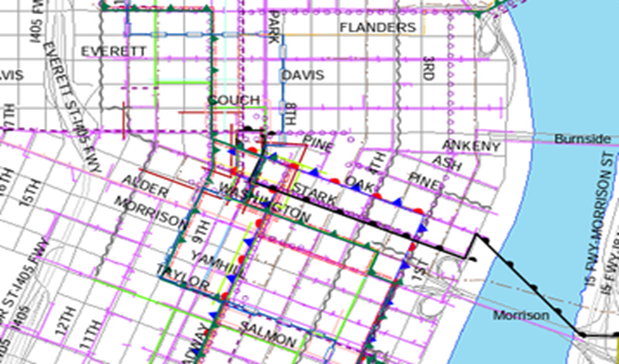
The 15-story Union Bank Tower, a 54-year-old office building in Portland, Oregon, is being sold for repurposing into a data center facility.[xii] The tower has 179,000 sq ft (17,000 sq m) of space, good power and networking connections, and is one block away from Pittock Block, Portland’s main Internet exchange, and 18 miles from the growing data center hub of Hillsboro.[xiii] Portland is now a strategic link between San Francisco and Seattle, and the tower is on the origin of the most popular routes to those cities, the 3Com Joint Trench and FTV Build.[xiv] It also has good connections to the Mid-West, East Coast, and the rest of the world and has 10 fiber-optic carriers terminating there through four entries in the underground parking garage.[xv] A total of 18 existing data center tenants already exchange data in its meet-me-room.[xvi] Thus, it is clear that other Downtowns have attracted data centers.
Business Incubators. Technology centers or tech incubators are another potential adaptive reuse of Downtown office space. Holland, Michigan is developing the Next Center. The Next Center will serve as a hub for innovation and business growth to strengthen West Michigan’s entrepreneurial ecosystem.[xvii] This three-story, 20,000-square-foot, state-of-the-art office building will be owned and operated by Lakeshore Advantage.[xviii] The Center will house a business incubator, community education space, and the offices of Lakeshore Advantage.[xix] St. Louis, which at one point faced over 200 vacant Downtown buildings, has launched the T-REX project. T-REX is a non-profit innovation and entrepreneur development center dedicated to strengthening the economic vitality of St. Louis, one startup at a time.[xx] Like a magnet, T-REX attracts innovation to our core downtown region. A coworking space, technology incubator, and entrepreneur resource center is core to T-REX offering an ecosystem where ideas are conceived, brought to fruition, and given room to grow.[xxi] T-REX is home to over 400 founders, developers, designers, mentors, educators, and more.[xxii] Transitioning vacant office space into a tech incubator is not challenging from a construction standpoint but involves developing substantial programming to support the development of startup companies.
Downtown Housing. Office to residential conversion remains the top new use brought to struggling office towers. Downtown Cleveland has been reborn around the development of housing. Downtown Cleveland has over 25,000 residents, more than double Cleveland’s younger and bigger brother Columbus. Twenty years ago, Cleveland responded to the post-9/11 recession and Great Recession with a series of strategies designed to reimagine and transform Downtown Cleveland from a 9-to-5 central business district into a diverse, vibrant, mixed-use neighborhood. This collection of strategies reimagined Downtown as a walkable, transit-oriented neighborhood. Over a ten-year period, this led to 32% population growth, 15.3% private sector job growth, and the conversion of over 5 million square feet of underutilized space in historic buildings to housing, hospitality, and other uses. Much of Cleveland’s success has been in the development community’s use of historic preservation tax credits from the state and federal government. Cleveland has over 108 completed State of Ohio Historic Preservation tax credit program projects while Columbus has less than 50. Cleveland is planning for its next phase of residential development Downtown through better utilization of the public spaces downtown through smaller, more frequent events, a more concerted effort at developing and sustaining a downtown retail sector, and additional lighting, wayfinding, and placemaking improvements and helping to facilitate the conversion of vacant office spaces into flex spaces or residential units.
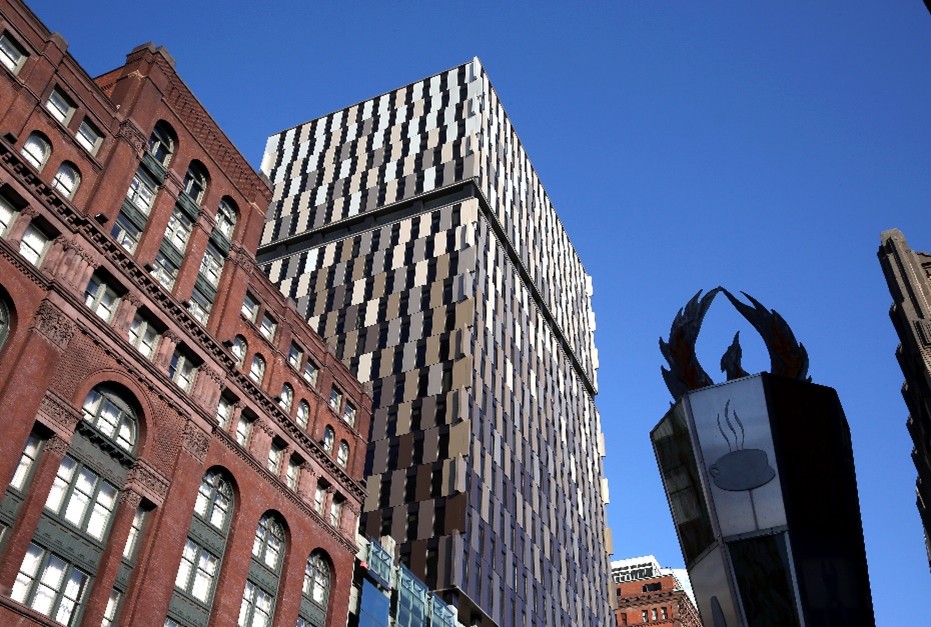
Office conversion is happening across the United States building neighborhoods among the skyscrapers in Downtowns.
[i] https://hub.jhu.edu/2023/10/18/hopkins-bloomberg-center-art-architecture/
[ii] Ibid.
[iii] Ibid.
[iv] https://www.nytimes.com/2023/10/03/business/office-conversions-universities-colleges.html
[v] https://downtowndayton.org/primary-care-facility-coming-soon-to-downtown/
[vi] https://www.scilife.io/glossary/life-science#:~:text=The%20life%20sciences%20industry%20comprises,improve%20the%20lives%20of%20organisms.
[vii] Ibid.
[viii] Ibid.
[ix] Ibid.
[x] Ibid.
[xi] Ibid.
[xii] https://www.datacenterdynamics.com/en/news/portlands-union-bank-tower-to-be-sold-for-conversion-to-a-data-center/
[xiii] Ibid.
[xiv] Ibid.
[xv] Ibid.
[xvi] Ibid.
[xvii] https://lakeshoreadvantage.com/the-next-center-announced/
[xviii] Ibid.
[xix] Ibid.
[xx] https://downtowntrex.org/
[xxi] Ibid.
[xxii] Ibid.