

Local and state governments are offering a range of economic development incentives to support office conversion projects. Local, state and federal government programs support office conversion projects. These economic development incentives and public finance tools include local and state government grants, loans, tax credits, exemptions and abatements for the development of residential projects.
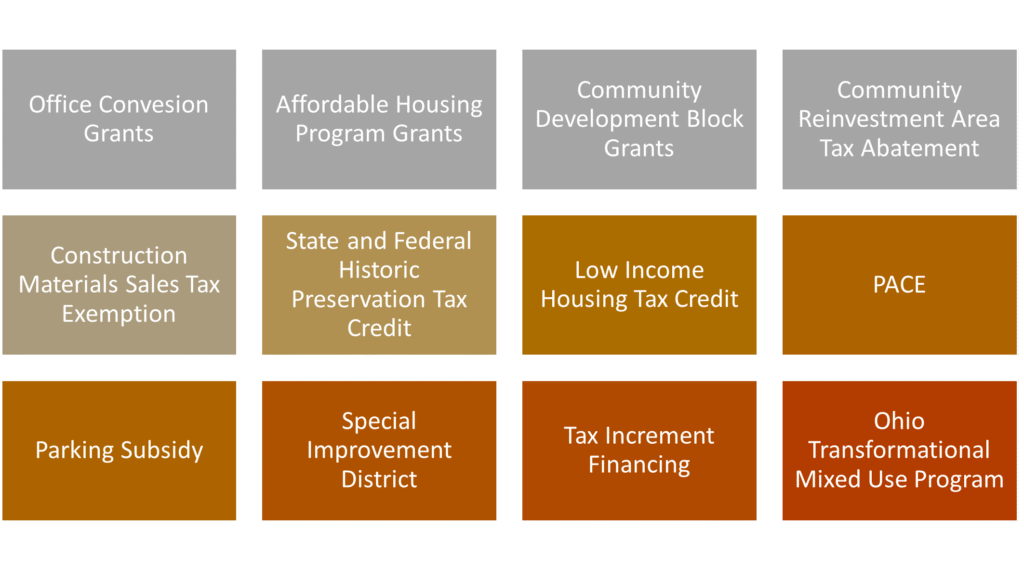
Local, State and Federal Downtown Development Economic Development Programs
Affordable Housing Program Grants. Cities like Columbus, Ohio provides $50 million annually in grants to support affordable workforce housing through city bond funds.
Affordable Housing Trust Financing. The Affordable Housing Trust for Columbus and Franklin County Ohio, (AHT) is a not-for-profit that provides loans of up to $5 million from a $100 million Housing Action Fund designed to address the need for affordable housing in Franklin County.
Community Development Block Grants (CDBG). Cities and states can use federal CDBG funds that can be used to fund infrastructure and economic development projects, public facilities installation, community centers, housing rehabilitation, homeowner assistance, to support acquisition, rehabilitation, reconstruction, and supporting infrastructure tied to low-moderate income benefits, slum/blight, or qualified urgent need.
Construction Materials Sales Tax Exemption. Local governments can provide a construction materials sales tax exemption for economic development and housing projects through a sale-leaseback agreement to reduce the cost of construction materials from paying the sales tax.
Local Government Capital Budget Grants. Cities and counties can provide direct grants to office conversion projects, usually for public infrastructure from their Capital Improvement Program (CIP) Budget.
Local Office Reuse Incentive. Cities from Calgary to Pittsburgh are offering office conversion loans and grants to developers that provides financing for the redevelopment of office conversion projects. Continental Plaza and advocate for Continental Plaza to receive funding under this new program.
Low Housing Income Tax Credits. The federal government operates several low income housing tax credits. The 4% Low Income Housing Tax Credit Program is not competitive but the 9% program is competitive. These tax credits are dollar-for-dollar reductions in federal tax liability. The 9% LIHTC is a limited resource with an annual credit ceiling determined by multiplying the state’s population by a statutorily defined per capita multiplier. Since 2016, the 9% LIHTC value has been calculated as 9% of a proposed project’s qualified basis over 10 years. Contrarily, the 4% LIHTC is not limited by the state’s annual credit ceiling; however, it’s value is only worth 4% of a project’s qualified basis over 10 years, or 2.25 times less, on average.
Tax Abatements. Cities across the United States can offer property tax abatements for new investment such as the Ohio Community Reinvestment Area Program (CRA) that can provide a 15-year, 100% property tax abatement for residential projects.
Historic Preservation Tax Credits. The federal and state government’s offer historic rehabilitation tax credit that provides a 20% federal income tax credit to taxpayers who undertake a substantial rehabilitation of a historic building while maintaining its historic character. The federal government’s Historic Preservation Tax Credit provides a 20% income tax credit is available for the rehabilitation of historic buildings that are determined by the Secretary of the Interior, through the National Park Service, to be “certified historic structures.” The buildings must be considered depreciable under the Internal Revenue Code, such as in a business, commercial, or other income-producing use. The State Historic Preservation Offices and the National Park Service review the rehabilitation work to ensure that it complies with the Secretary’s Standards for Rehabilitation. The Internal Revenue Service defines qualified rehabilitation expenses on which the credit may be taken. Owner-occupied residential properties do not qualify for the federal rehabilitation tax credit.
PACE. PACE programs allow a property owner to finance the up-front cost of energy or other eligible improvements on a property and then pay the costs back over time through a voluntary assessment. The unique characteristic of PACE assessments is that the assessment is attached to the property rather than an individual.
Parking Subsidy. Parking subsidies can be provided for office conversion projects as many cities own parking facilities that can be used as an economic development incentive.
Tax Increment Financing (TIF). 49 states use TIFs to capture future property tax revenue over a term based upon future investment for use on public infrastructure such as roads, water, sewer, utility, and parking.
Transformational Mixed-Use District (TMUD). The state of Ohio TMUD program provides $100 million in premium insurance tax credits annually for up to 10% of development costs for large-scale mixed-use developments in major and non-major cities awarded by the Ohio Department of Development for projects that exceed $50 M in development costs, includes the renovation, rehabilitation, or construction of at least one new or previously vacant building; is 15 stories in height, or is at least 350,000 sq. ft., or is a project which creates $4 million in annual payroll.
Special Improvement District SIDs. Many staters permit the creation of SIDs which is approved of by a vote of property owners in a district to levy a special assessment that can fund capital projects like façade grants to update office buildings appearance and operational support for office district neighborhoods.
A wide range of economic development incentives exist to support office conversion across the United States.