

Ohio Governor Mike DeWine and the Ohio General Assembly continued Ohio’s push to promote the creation of high-wage jobs and capital investments by promoting the state’s economic development. Efforts included in the recently enacted state of Ohio operating budget include reducing the tax burden on Ohioans, providing regulatory relief to industry, providing an enhanced focus on addressing the national housing crisis and funding critical state economic development programs.
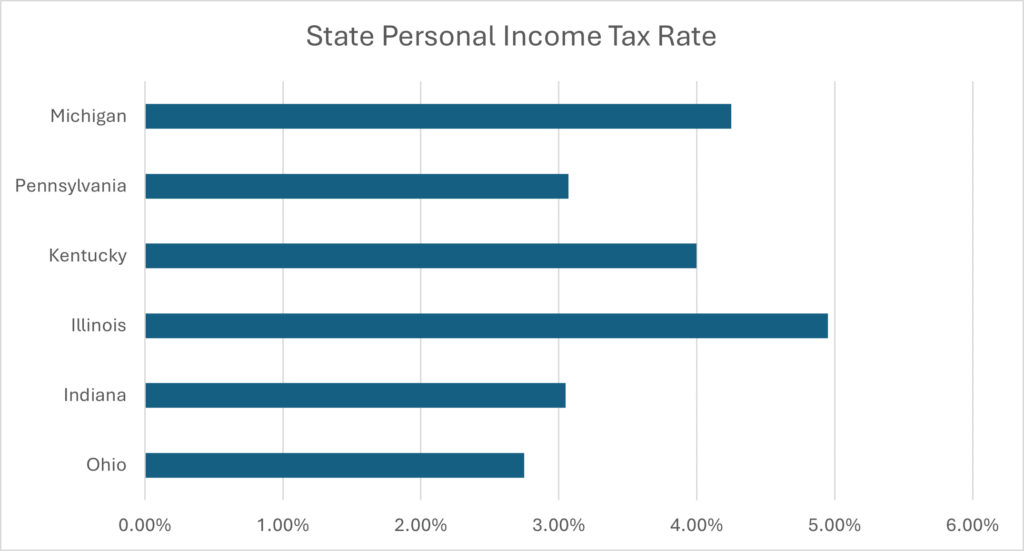
State of Ohio Tax Policy Changes. Ohio moved to a flat state income tax of 2.75% that provide a tax cut of over one billion dollars for Ohio taxpayers and position Ohio as having the lowest personal income tax rates in the Great Lakes region.
Regulatory Relief. In a major move to support more local economic development, the Ohio General Assembly increased the local referendum threshold for voter signature requirements to 35% of those that voted in the last Governor’s election in a township, Home Rule Township and statutory city whose previous signature requirements were 15%, 15% and 10% respectively. Also, the Ohio General Assembly banned referendums against local governments at a mega site project.
Local Economic Development Program Changes. The Ohio General Assembly made changes to how local government economic development programs operate including:
- Allows a county, municipality, or home rule township to amend an existing community reinvestment area agreement to extend the term of the tax exemption to a total of 30 years for an existing building that is expected to be the site of a megaproject, allows a building to qualify for a CRA tax exemption as part of a megaproject so long as it is owned or occupied, as opposed to owned and occupied, by a megaproject operator or supplier, and establishes that a political subdivision that does not own the property subject to a CRA exemption, with an obligation to pay property taxes on that building, is not a required party to an agreement required for commercial CRA property tax exemptions.
- Modifies the New Community Organization Law to ensure limited home rule townships in large counties have additional autonomy to undertake economic development.
- Exempts regional transit authorities from the bill’s eminent domain restrictions which maintain current law for RTAs, while maintaining bill’s provisions for other subdivisions including not permitting other local governments to use eminent domain for trail development.
- Allows cities and townships to increase resort area taxes up to 2.5% subject to voter approval (currently taxes up to 1.5% cap are enacted without voter approval).
- Allows a board of commissioners, inside a designated resort area, to increase their lodging tax by 1% for public safety needs.
- Prohibits port authorities from entering into agreements for non-public entities that allow the private party to benefit from the sales tax exemption on construction materials without first obtaining county commissioner approval, if the project is located outside the port authority’s territorial jurisdiction, and excludes construction contracts between port authorities and private entities from the sales tax exemption for construction materials purchased for government buildings if the required approval has not been obtained.
Ohio’s Housing Programs. The Ohio General Assembly continued efforts to address the national housing crisis’ impact on the Buckeye State through the creation of a few programs, including:
- $25M the Residential Economic Development District Grant Program (REDD) to provide grants to political subdivisions that adopt pro-housing policies related to large-scale workforce housing and revised criteria to incentivize projects with flexible zoning requirements and adds regional planning commissions to the list of entities that may partner with subdivisions to apply for grants.
- $100M for the Residential Development Revolving Loan Program to $100M that will provide infrastructure funding to support residential development in rural markets.
- Maintains the Ohio Housing Finance Agency as an independent entity.
- Modifies the Welcome Home Ohio tax credit criteria to increase the marketability of the credits.
Ohio Economic Development Programs. The Ohio General Assembly made changes to the state’s economic development program run primarily out of the Ohio Department of Development, including:
- Provides $200 M in funding for the Ohio Brownfield Redevelopment Program and broadens who can apply for funding and what program funds can be spent on.
- Expands the purpose of the Roadwork Development and Facilities Establishment Funds for developments associated with tourism and sports attractions, but does not permit these funds to be used for retail facilities
- Creates a billion-dollar sports facilities fund to support the planned Cleveland Browns development in Brook Park and other sports facilities across the state through the one-time use of a portion of the state’s Unclaimed Funds Account
- Doubles the annual Opportunity Zone tax credit cap to $50M per FY and modifies the Ohio Opportunity Zone Investment Income Tax Credit to limit the total amount issued for a single project to $5M.
- Sets the annual Film and Theater Production tax credit cap at $50M per FY, allows an applicant for the Film and Theater Tax Credit to use an investment intent letter as documentation demonstrating that they have secured required funding, and adds companies that present Broadway performances as eligible applicants for the Film and Theater Tax Credit in addition to the current eligibility for producing companies.
- Sets the annual Historic Rehabilitation tax credit cap at $60M per fiscal year, prohibits ODOD from using building vacancy or underutilization as part of the criteria for awarding historic rehabilitation tax credits, and increases the percentage of rehabilitation costs a certificate owner may claim as a credit from 25% to 35% for a project that is not located in a municipality with a population of at least 300,000.
- Reauthorizes the Transformation Mixed Use Development (TMUD) tax credit cap to $150M per FY, makes substantial changes to the award criteria to emphasize projects with local support and projected economic benefit, requires that only the property owner can apply for the credit, and requires cost estimates be submitted with an application for the credit.
- Clarifies that the statutory frameworks of the Ohio Opportunity Zone, Film & Theater, Historic Rehabilitation, and TMUD tax credit programs remain in permanent law, but issuance of new credits are subject to authorization by the General Assembly each fiscal biennium ensuring tax credit recipients will have the stability of the program to claim their credits while giving future General Assemblies better oversight of tax expenditures.
- Ohio’s Rural Industrial Loan Program is reduced to $2,500,000 annually in funding.
Not all the work of the Ohio General Assembly was positive for the economic success of the state. The General Assembly eliminated the data center sales tax exemption but overall, the state of Ohio’s operating budget was supportive of the state’s continued effort to succeed in a challenged, global economy.
The Montrose Group is engaged in negotiating for local economic development incentives, advising local communities on how to use local economic development incentives and advocating for funding from state of Ohio government agencies for public and private sector clients, and please contact Dave Robinson at drobinson@montrosegroupllc.com if you need assistance with negotiating or gaining local or state economic development incentives in Ohio.