

Winning a land use entitlement campaign now takes the skills of a political operative, not just a land use attorney. The numbers are unambiguous, and they should alarm every economic developer, site selector, and commercial real estate professional in the country.
Why a Land Use Entitlement Campaign Now Decides Approval
For years, an entitlement was a legal process. Today it is a political one. The legal work still matters. Zoning compliance, traffic studies, and environmental review remain necessary. However, they are no longer enough. A project can be legally unimpeachable and still lose.
Opponents have learned a simple lesson. You do not need to win the legal argument. Instead, you need to win the room. Economic developers must learn that same lesson, because the public hearing has shifted from a formality into a battleground. Zoning boards and county commissioners once deferred to technical staff. Now they respond to constituents who show up in force and vote.
The Numbers Behind Rising Opposition
Public opinion has turned fast. In early 2025, national polling showed roughly 60% of Americans supported data center construction. By April 2026, that number had flipped. According to Change Research, 53% of voters now oppose it, with only 36% in favor.
The trend holds across the political spectrum. Gallup found that seven in ten Americans oppose data center construction near where they live. Among Democrats, 75% oppose local data center projects. Among Republicans, 63% do as well. Morning Consult also tracked support for an outright construction ban, which grew from 37% to 41% in a single month in late 2025.
Moreover, the opposition is not abstract. It is rooted in specific fears: electricity bills, water consumption, industrial character imposed on rural land, and a sense that distant corporations decide without community input. A POLITICO survey found that most Americans report low familiarity with how data centers operate. In the absence of knowledge, communities default to perceived risk. That knowledge gap is where opposition takes root.
Data centers are simply the highest-profile example. The same dynamics now reshape entitlement battles for warehouses, solar farms, manufacturing facilities, and large residential developments. As a result, communities are better organized, better informed by social media, and more politically sophisticated than they were a decade ago.
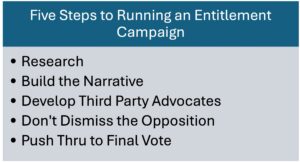
Five Steps to Run a Winning Land Use Entitlement Campaign
The Montrose Group recommends five steps for any land use entitlement campaign.
1. Commission the Research Before the Opposition Does
Before a project is announced, conduct community attitude research. Structured interviews, focus groups, and targeted surveys reveal what residents already believe about development in their area. Above all, identify the persuadable middle. Opposition movements are typically built by a vocal 10 to 15 percent, so the persuadable majority is where the campaign is won or lost. Good research also defines the economic impact and shapes a site plan that is defensible with neighbors.
2. Build the Community Narrative First
The first story told about a project is the one that sticks. Therefore, developers and economic development organizations must establish the affirmative narrative early. Jobs, tax revenue, infrastructure investment, and community commitments should lead. Earned media, community meetings, and direct stakeholder engagement should begin before the permit application is filed. In addition, put the social media vehicles in place that opponents will surely use.
3. Recruit Visible Local Validators
Elected officials, employers, school administrators, labor leaders, and chamber executives carry credibility that proponents cannot manufacture alone. Identify who holds trust in the community, and engage them early. For example, a school superintendent explaining what new commercial tax base means for classroom funding is more persuasive at a township meeting than any attorney. Third-party advocates win local entitlement campaigns.
4. Treat the Opposition as a Constituency
The instinct to dismiss opponents as misinformed is both wrong and counterproductive. Most opposition reflects genuine concerns about change, uncertainty, and local control. Consequently, projects that acknowledge those concerns and make enforceable commitments outperform those that do not. Community benefit agreements, binding development standards, and transparent communication convert some opponents and neutralize many more. Listen before the announcement. Meet impacted neighbors in their homes. Stay open to site plan and traffic changes that reduce the impact.
5. Sustain the Campaign Through the Final Vote
Political campaigns do not end until election day, and entitlement campaigns do not end until approval is granted. Developers who win early support and then go quiet often find that opposition has reorganized by the final hearing. Therefore, consistent communication, responsive engagement, and a visible community presence are the disciplines that hold a coalition together.
Treat Public Support as Infrastructure
The communities that win the economic development competition of the next decade will treat public support as infrastructure. In other words, it must be built deliberately, maintained actively, and never taken for granted.
Contact the Montrose Group’s Dave Robinson at drobinson@montrosegroupllc.com if you need assistance with negotiating land use entitlements and economic development incentives.