

A Joint Economic Development District is one of Ohio’s most effective economic development tools. It lets local communities create a win-win for projects in a township without annexing the site into a municipality. As a result, states that want a cooperative growth model can look to Ohio’s JEDD program first.
Ohio communities that want to drive growth, attract businesses, and expand their tax base have a uniquely effective option. Whether you are a township trustee, city official, business owner, or economic development professional, understanding how JEDDs work can open new doors. Consider one example. Defense-tech firm Anduril plans 4,000 jobs in Central Ohio in part because the local community formed a JEDD. That district provided local tax revenue, water and sewer service, roadway infrastructure, and funding for the site’s developer.
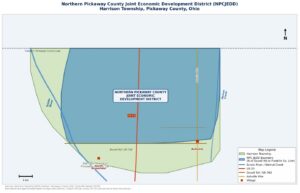
What Is a Joint Economic Development District Under Ohio Law?
A Joint Economic Development District is a special zone created under Ohio Revised Code Section 715.70 et seq. In short, it is a contractual partnership between a municipality and an unincorporated township. The municipality extends its income tax into a designated area within the township, usually a commercial or industrial corridor, without annexing the land. In return, the township keeps its identity and local governance while sharing the revenue. JEDDs are therefore among Ohio’s most flexible and community-driven strategies.
How Are JEDDs Created?
Creating a JEDD begins with a contract between the municipality and the township. That contract must define the district boundaries, the income tax rate, and how revenues are shared and used. A board of directors made up of representatives from both communities then governs the district. Importantly, landowners and businesses within the proposed boundaries must vote to approve it. Once approved, the municipal income tax begins to apply to businesses and employees inside the district.
Where Can Communities Set Up a JEDD?
JEDDs are established in unincorporated township areas that sit near a municipality. They are especially common along highway corridors, near interstate interchanges, in industrial parks, and in fast-growing retail areas outside city limits. In practice, any Ohio township and adjacent municipality can explore a JEDD when both sides want planned growth and are willing to share the benefits and responsibilities.
When Does a JEDD Make Sense?
A JEDD makes sense when a township has developable land but lacks the municipal services, such as water, sewer, and road maintenance, needed to attract employers. It also makes sense when a municipality has service capacity and taxing authority but lacks available land. In addition, JEDDs are valuable when annexation is politically sensitive. They offer a cooperative alternative that avoids conflict while still enabling growth, which makes them ideal for targeting specific corridors or industrial sites.
Why Communities Set Up a JEDD
For municipalities, a JEDD expands the income tax base beyond city limits and generates new revenue without adding land or residents. For townships, it brings municipal-quality infrastructure to township land and produces shared tax revenue for local services. Both partners gain job creation, higher property values, and a stronger regional economy. Furthermore, JEDDs reduce competitive friction between neighbors by replacing competition with cooperation.
How JEDDs Operate
A board of directors appointed by the municipality and township governs each JEDD. The board oversees operations, administers the revenue-sharing agreement, and coordinates infrastructure and service delivery. The municipal income tax is collected from businesses and employees inside the boundaries, and the proceeds are split under the governing contract. The board may also issue debt, enter contracts, and lead planning activities to promote development.
What a JEDD Can Do for Communities and Companies
For communities, a JEDD generates sustainable income tax revenue, funds infrastructure, and creates a stable platform for long-term planning. For companies, locating in a JEDD often means access to municipal water, sewer, and well-maintained roads without the uncertainty of annexation. JEDDs can also pair with other Ohio incentives, such as Tax Increment Financing and Enterprise Zone agreements, to build comprehensive packages. The result is a win-win framework for regional growth, especially for corporate site location and real estate projects seeking greenfield sites.
For assistance using a JEDD or other economic development tools to foster high-wage jobs and capital investment, contact Dave Robinson at drobinson@montrosegroupllc.com.