

Dead malls. Half-empty office towers. Fenced-off industrial acreage. Communities tend to treat these as liabilities — blight on the tax duplicate and drags on adjacent value. In reality, they are the most valuable land a community has access to, because the expensive part is already paid for: water and sewer capacity, arterial road frontage, electric service, and a location people already know how to find. A redevelopment plan is what converts that latent value into projects. Without one, these sites sit in limbo for a decade while ownership fragments, environmental conditions worsen, and remediation costs compound.
What Can These Sites Become?
Dead malls carry 40 to 80 acres of assembled land with signalized access. Therefore, they suit mixed-use town centers, medical campuses, last-mile logistics, senior housing, or civic anchors like libraries and recreation centers.
Obsolete office buildings convert to residential, hotel, student or workforce housing, life science and lab space, or ground-floor retail with upper-floor coworking. Conversion feasibility hinges on floor plate depth, window line, and riser capacity — not on price alone.
Brownfields support advanced manufacturing, energy and data center uses, solar arrays, and distribution. Where remediation economics fall short, they become green space and stormwater infrastructure instead.
The Research the Redevelopment Plan Must Do
Credible redevelopment plans are built on hard data, not aspiration:
- Market: absorption rates, comparable rents and sale prices, and realistic capture analysis by product type
- Environmental: Phase I and, where warranted, Phase II assessments with remediation cost ranges
- Physical: utility capacity, structural and floor plate analysis, demolition, and abatement estimates
- Financial: current versus projected assessed value, TIF increment capacity, and the financing gap
- Legal: ownership and lien structure, CMBS special servicer status, title defects, and entitlements
Who Must Be at the Table
Property owners and their lenders control timing, because nothing moves without site control. Beyond them: the county land bank and port authority for acquisition and financing tools, the county auditor on valuation, utilities on capacity, the state environmental agency on cleanup and liability release, the school district on TIF revenue-sharing, neighborhood residents and adjacent businesses, and the brokers who will ultimately price the risk.
Action Steps Worth Adopting
If the data dive defines who a community is, and the listening session defines who it wants to become, the action steps define how to get there:
- Establish site control — option, land bank acquisition, or negotiated agreement with the lender.
- Complete environmental assessment and pursue a state cleanup program with liability protection.
- Adopt a market-tested land use concept and pre-approve zoning so entitlements are not a developer’s risk.
- Assemble the financing stack: TIF, brownfield grants, historic and new markets tax credits, and port authority bond capacity.
- Issue a developer RFQ/RFP against a defined program rather than waiting for an unsolicited proposal.
- Phase the project so early wins fund later ones, and name a single accountable entity.
- Set metrics — jobs, valuation, units, private investment leveraged — and report against them publicly.
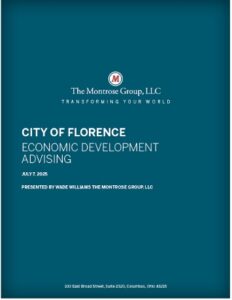
Case Study: Florence Mall, Florence, Kentucky
The Montrose Group completed an economic development strategic report for the redevelopment of the Florence Mall site in Florence, Kentucky. The plan outlines a strategy to transform the mall from a traditional retail hub into a vibrant mixed-use community. It leverages innovative redevelopment models, including full-scale redevelopment, phased strategies, and public-private partnerships, drawing on benchmarking of comparable projects such as City Center Springdale and Ovation in Newport, KY.
Key highlights include a market analysis of the struggling mall, visioning for potential reuses, and a review of public finance tools — Tax Increment Financing, Industrial Revenue Bonds, and Kentucky Tourism Development Act incentives. Clear action steps followed: land acquisition, engaging experienced developers, and securing public and private funding.
Redevelopment is not slower than greenfield development. It is only slower when nobody has planned it.
The Montrose Group has completed over sixty economic development plans for public and private sector clients. Contact Dave Robinson at drobinson@montrosegroupllc.com if you need assistance with any economic development plan.