

States across the Union face a major housing supply challenge that has transformed into a critical economic development impediment. A house is where a job sleeps at night. Many states have had recent success in attracting major economic development projects but companies considering potential corporate site locations are not only reviewing the availability of workforce and the cost of doing business but also whether their employees can find a place to live that they can afford. States like Indiana have figured out that how housing is regulated has a major impact on how many new homes are developed. As the chart below illustrates, Indiana produces the same number of new homes as Ohio, and Indianapolis continues to produce more housing than its economic and demographic twin of Columbus, Ohio.
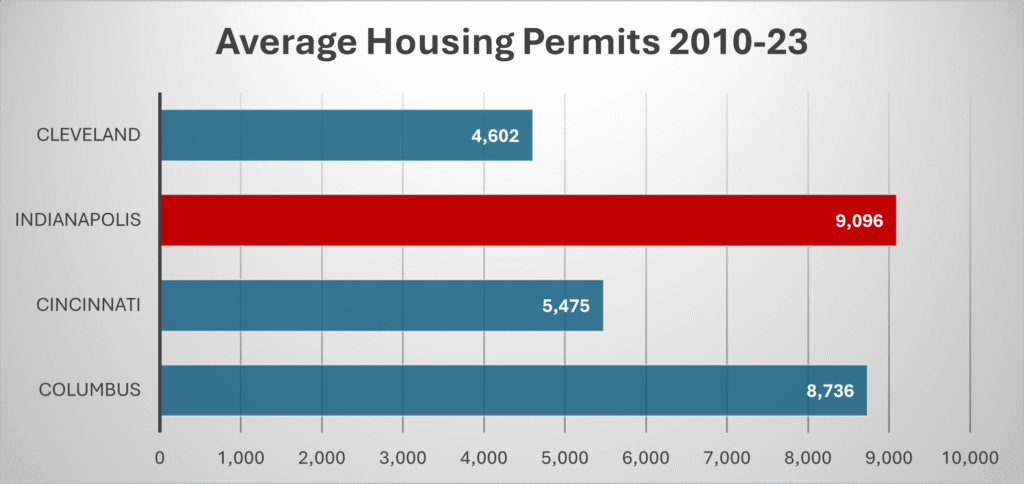
Indiana permits cities to regulate zoning in adjacent townships and does not permit voters to launch referendum attacks on local government zoning votes. States like Ohio have suffered from the lack of new housing development that resulted in dramatic increases in Ohio’s property tax rates as home prices continue to rise. Central Ohio’s average new home price is over $500,000 while Indianapolis’ average new home price is $392,000.
To address the Ohio Housing challenge, Governor Mike DeWine and members of the Ohio General Assembly started to address the local government regulatory challenges impeding housing development as well as provided targeted funding to support the development of low income housing and public infrastructure in rural markets and communities that support the development of housing tied to major economic development projects.
Local Government Referendum Reform. Ohio is one of two states in the union that permits local voters to overturn a zoning ordinance enacted by a township or municipality with a direct vote of the people. The Ohio General Assembly took a major step toward addressing the regulatory challenge by increasing the threshold of the number of valid voter signatures required to 35% of the registered voters who voted in the last Governor’s election in that local jurisdiction in townships, Home Rule townships and statutory cities. As a Home Rule state, many Ohio cities have adopted charters that govern over state law how they operate but the General Assembly increased the threshold for non-charter cities and all townships. Current law only requires 10% of the voters in a statutory city and 15% of the voters in Home Rule townships and townships in the last Governor’s election. Most townships in Ohio are small and rural with fewer than 3000 voters—meaning the 15% referendum threshold may only require less than 100 signatures to overturn a major housing or commercial project. The Ohio General Assembly also abolished the referendum on local government actions tied to major economic development projects known as “mega projects.” This change is critical to not only gaining zoning approvals needed for projects creating thousands of jobs and providing billions in economic investment but also supporting the development of housing surrounding these projects that will be required for new workers to support these projects.
Residential Economic Development Districts (REDDs). The Ohio General Assembly created the REDDs program to support housing development tied to major economic development projects. $25 M over two years in funding was provided for the REDDs program directed to a 20-mile development zones around major economic development projects creating $700M in capital investment and at least 700 permanent jobs. REDDs will be a grant program for counties, townships, and municipal corporations located within 20 miles of a “major economic development project.” This program allows these applicants to collaborate with a housing developer, a port authority, a council of government, a regional planning commission, or one or more other counties, townships, or municipal corporations. Requires grant funds to be used for the following purposes: providing capital for housing development through grants or loans; acquiring and readying sites for development; providing financial assistance for housing-related infrastructure projects; addressing additional service or public safety needs; and any other purpose deemed appropriate by the Ohio Department of Development (ODOD). The program requires the applicant for a grant to demonstrate that the applicant has, or has imminent plans to, adopt and implement “pro-housing policies” and to approve a “major workforce housing project” that includes at least 100 units. Provides criteria for the ODOD to score and prioritize applications that adopt more pro-housing policies, specifically regarding: density, lot size, side yard setbacks, open space, inspection, plan, impact, water and sewer tap fees, use of water pipe type, use of rigid and flexible pavement types, traffic studies, thoroughfare plans, and sanitary sewer or water extensions. Requires ODOD to adopt rules to implement and administer the program and to finalize and publish initial application procedures and scoring metrics no later than December 31, 2025.
New Residential Development Program (RLF) – The Ohio General Assembly created a new revolving loan fund administered by ODOD with $100 million in SFY 2026 funding to make low-interest loans for infrastructure improvements (water, sewer, road, electric, gas extensions) serving new single-family housing development in rural areas. The RLF program will administered by ODOD to fund improvements to the infrastructure necessary to support the construction of new, single-family residential dwellings in the rural areas of Ohio. This program will limit funding to local government entities located in counties having a population of 75,000 or less and that issued fewer new construction permits for single-family homes than the average number of such permits for counties in Ohio in the most recent calendar year, and requires borrowed funds to be solely used for projects involving the development, repair, or upgrade of water, sewer, road, electric, or gas infrastructure necessary to service dwellings meeting certain statutory requirements, including that the dwellings do not receive a federal low income housing tax credit. The RLF Program limits the loan amount to 50% of the cost of the infrastructure developments, repairs, or upgrades, or $30,000 per single-family residential dwelling to be served by that infrastructure, whichever is less, and requires political subdivisions receiving loans under the program waive certain building, zoning, and planning requirements concerning the residential development project served by the infrastructure developments, repairs, or upgrades. Eligible borrowers will be required to submit, as a part of an application for a loan under the program, the proposed or recorded plot of the subdivision that is the basis of the development project, and prohibits ODOD from using more than $500,000 annually of the money deposited to the RLF Loan Fund for administrative expenses, and from establishing a schedule of fees and charges to be paid by applicants and loan recipients. The RLF Program requires that the interest rate for loans made under the program must be the effective federal funds rate in effect at the time the loan agreement is made, and requires a borrowing subdivision to exempt improvements constructed from loan proceeds from property tax, requires such properties make payments in lieu of taxes to the subdivision equal to the forgone tax, and requires the subdivision to use those payments to pay off the loan. The RLF Program will requires all amounts received as repayment for loans made under the program to be credited to the RLF Loan Fund, and exempts projects to develop, repair, or upgrade infrastructure needed for the construction of single-family, residential dwellings in Ohio rural areas using these loans from the Prevailing Wage Law. Program, to be used to support the Residential Development Revolving Loan Program. Reappropriates the unexpended, unencumbered portion of the ALI at the end of FY 2026 to FY 2027.
Welcome Home Ohio Program Improvements – The Welcome Home Ohio (WHO) program is designed to provide grants for the purchase of qualifying residential properties, the cost of construction or rehabilitation, or a nonrefundable tax credit for qualifying activities. The Ohio General Assembly awarded WHO an additional $91.25 million, divided between its Acquisition and Construction grant programs. The Ohio General Assembly made WHO program changes that included:
- “Qualifying median income” has been updated from 80% to 120% of the median income for the county where the residential property is located.
- The maximum grant amount per qualifying residential property increased from $30,000 to $100,000 for both the acquisition and the construction grants
- Allow up to $2,000 per property in grants for the required financial literacy counseling.
- Owners are now required to maintain ownership and occupy the property as their primary residence for at least 3 years, reduced from 5 years.
- Owners cannot sell the qualifying property within 15 years, reduced from previously 20 years, except to an electing subdivision, county land reutilization corporation, qualified nonprofit developer, or income-qualified individuals.
The Ohio General Assembly maintained $45.6 million in funding with enhanced program features: income limits increased to 120% AMI, resale price cap raised to $220,000, and grant amounts boosted to $100,000 per property. Adds “qualified nonprofit developers” as eligible applicants for grants to purchase or rehabilitate residential property, extends the WHO tax credit from the end of FY 2025 to the through the end of FY 2027, and caps the total amount of credits awarded in the biennium at $20 million. The Ohio General Assembly worked to improve the operation of the program through a series of policy changes including:
- Adds certain “qualified nonprofit developers” as eligible applicants for grants to purchase or rehabilitate residential property under the WHO.
- Extends the WHO tax credit from the end of FY 2025 to the through the end of FY 2027, and caps the total amount of credits awarded in the biennium at $20 million.
- Increases the amount of the WHO tax credit from one-third of the construction and rehabilitation costs to 90% of such costs.
- Increases the amount by which penalties are reduced annually from one-twentieth to one third of the total amount of tax credit awarded for each year the original or subsequent buyer with a qualifying income resided in the home Raises the income eligibility threshold to purchase WHO-funded property from 80% to 120% of the median income of the county in which the property is located.
- Increases the amount for which WHO-funded homes may be sold from $180,000 to $220,000.
- Allows WHO funds to be used to acquire or rehabilitate manufactured homes.
- Decreases the minimum square footage WHO-funded units in a multi-unit property from 1,000 to 800 square feet.
- Requires, if grant funds are used to construct or rehabilitate a unit in a multi-unit property, that no portion of the funds are used to construct or rehabilitate portions of the building that are for nonresidential uses, except for common areas used by the occupants of the residential units and improvements that serve both the residential units and the other portions of the building.
- Increases the maximum grant for land banks and qualified nonprofit developers to construct or rehabilitate qualifying residential property from $30,000 per home to $100,000 per home.
- Caps the grant amount for land banks and qualified nonprofit developers to acquire qualifying residential property at $100,000 per home.
- Allows up to $2,000 in each WHO grant to be used to fund the financial literacy counseling that grant recipients are required, under continuing law, to provide to purchasers of the property.
- Requires that the counseling be provided over six months, rather than one year and clarifies that financial literacy counseling is to be provided before the application for a WHO Program tax credit.
- Requires such counseling to be provided by a “qualifying counseling provider,” meaning an individual, business, nonprofit organization, or political subdivision that is licensed, certified, or authorized to provide homeownership counseling and financial literacy as one of its primary functions, including housing counselors certified by the U.S. Department of Housing and Urban Development or the Ohio Housing Finance Agency.
- Reduces from 5 years to 3 years the amount of time the purchaser of a WHO-funded home must agree to occupy the home as a primary residence and not rent it to any other person.
- Reduces from 20 years to 15 years the amount of time the purchaser of a WHO funded home must agree to not sell the home to anyone whose income meets the WHO eligibility thresholds.
- Allows a grant or tax credit recipient to include in the deed restriction a right of first refusal to repurchase the property in order to ensure that subsequent purchasers meet the income eligibility thresholds.
States like Ohio are working to address the housing crisis but have much further to go related to how local governments regulate housing development.
Contact Dave Robinson of the Montrose Group at drobinson@montrosegroupllc.com if you need help with a residential development policy or other economic development or policy matter.