

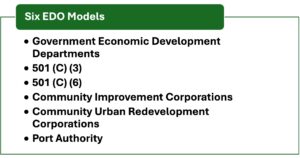
Economic development programs are implemented at state and local levels by government entities or Public-Private Partnerships (PPPs) known as Special Purpose Entities (SPEs). Deciding between a public or private economic development organization model is a major consideration for governments and regional planners.
State-Level Economic Development Models
Most U.S. states operate economic development programs within state government. For example, Pennsylvania consolidates multiple teams under the Business PA organization, including the Governor’s Action Team, Foreign Direct Investment (FDI), and Trade & Exports programs. This centralized public-sector model allows the state to:
-
Provide local community support
-
Offer economic development incentives for businesses
-
Keep negotiations confidential until approvals
States can leverage taxpayer-funded budgets to provide large-scale incentives and coordinate complex economic development projects.
Private Sector State Models
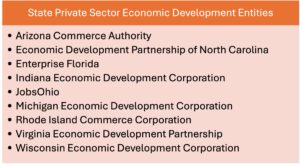
About ten states operate some version of a private sector economic development entity. These organizations are usually run by boards with private-sector leaders and operate more flexibly than government agencies.
Example: JobsOhio
-
Funded by state liquor store profits, creating a billion-dollar budget
-
Supports regional economic development groups across all 88 counties
-
Provides incentives directly to businesses at “business speed”
While private-sector models are agile, most lack the resources of large state government programs and often function as marketing arms for the state.
Regional Economic Development Models
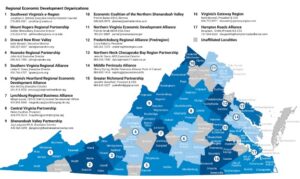
Some states use regional models to coordinate multi-county development. Virginia’s GO Virginia divides the state into nine economic regions. Private-led organizations like the Roanoke Regional Partnership collaborate with the state-level Virginia Economic Development Partnership to attract investment, balancing public oversight with private sector agility.
Local Economic Development Organizations
Government-Run Local Programs
Most local governments operate development departments that handle housing, land use, and tax incentives. Advantages include:
-
Direct access to zoning and permitting
-
Ability to approve property tax abatements and public infrastructure projects
Challenges include slower government processes, lower salaries, and civil service constraints that may make attracting top professionals difficult.
Private Nonprofit and Quasi-Governmental Entities
-
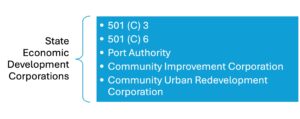
501(c)(3) charitable organizations focus solely on economic development.
-
501(c)(6) Chambers of Commerce engage in both economic development and lobbying.
-
Community Improvement Corporations (CICs) and Ohio’s Community Urban Redevelopment Corporations:
-
Can buy, sell, and construct property improvements
-
Operate with partial government oversight but retain negotiation flexibility
-
Target urban redevelopment, often leveraging public-private partnerships and tax exemptions
-
Ohio Port Authorities demonstrate how quasi-public entities can drive regional development by providing tax-exempt financing and flexible project ownership.
Choosing the Best Model
-
Public sector model: Large budgets, policy integration, strong oversight. Best for large-scale projects and direct community development.
-
Private sector model: Flexible, business-oriented, able to act confidentially. Best when funded with substantial independent revenue (e.g., JobsOhio).
The ideal model depends on funding, local capacity, and desired balance between accountability and flexibility.