

The Opportunity Zone program, created in 2017, is designed to spur economic growth and job creation in low-income communities while providing tax benefits to investors. Opportunity Zones are federally certified census tracts eligible for investment by Qualified Opportunity Zone Funds (QOFs) using capital gains revenue. Opportunity Zone 2.0 economic development efforts are now stronger than ever following recent congressional action making the program permanent.

How the Opportunity Zone Program Works
The OZ program provides three core tax benefits for investing unrealized capital gains:
- Temporary deferral — Investors can place assets with accumulated capital gains into Opportunity Funds. Those gains are not taxed until the end of 2026 or when the asset is sold.
- Basis step-up — For capital gains held in an Opportunity Fund for at least 5 years, the investor’s basis increases by 10%. At 7 years, it increases by 15%.
- Permanent exclusion — For investments held at least 10 years, investors pay no taxes on any capital gains produced through their Opportunity Fund investment.
What Changed With Opportunity Zone 2.0
Congress made the OZ program permanent — now called OZ 2.0 — and introduced several key updates:
- OZ incentives are no longer set to expire and are now a permanent part of the Internal Revenue Code.
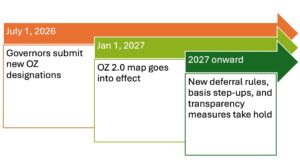
- Any qualifying capital gain invested into a QOF on or after January 1, 2027 will be deferred for exactly five years from the date of that investment — the clock starts at investment, not at a fixed program end date.
- Standard QOF investors receive a 10% step-up in basis after 5 years, meaning 10% of the original deferred gain is excluded from taxation when recognized.
- Rural QOF investors (outside cities of 50,000+ residents) receive a 30% step-up in basis after 5 years — three times the standard benefit — and only need to meet a 50% substantial improvement test instead of the usual 100%.
- At least 33% of new OZ designations in 2027 must be in rural areas.
- Funds and investors must now provide greater disclosure, including project-level investment data, job creation numbers, affordable housing units, business revenue and employment outcomes, and community benefit indicators.
OZ 2.0 Redesignation and Eligibility
Current Opportunity Zones will need to be redesignated based on recommendations from state Governors, beginning July 2026 and certified by the U.S. Treasury. To check whether a site qualifies under OZ 2.0, an interactive map of eligible census tracts is available here.
Ohio’s State Opportunity Zone Program
Ohio complements the federal program with its own state OZ tax credit. The Ohio Opportunity Zone Program offers a 10% non-refundable, transferable tax credit on investments made into qualifying Ohio Opportunity Funds targeting economically distressed areas. Key details:
- Investors receive a 10% credit on investments in Qualified Opportunity Zone Property
- The credit can be sold or transferred once by the taxpayer
- Ohio taxpayers must apply in January following the investment year
- Investments must be made through Qualified Opportunity Funds focused on designated Ohio zones
- Unused credits can be carried forward up to five years
- Fiscal year 2025 allocations of $25 million were quickly exhausted, reflecting record demand
Opportunity Zone 2.0 Timeline
Why Opportunity Zone 2.0 Matters
A permanent OZ program brings greater investment stability and long-term planning confidence. Enhanced rural incentives create a new frontier for economic development in areas traditionally underserved by private capital. Expanded transparency requirements address longstanding criticism of the original program and open the door for evidence-based improvements going forward.