

An Ohio Transportation Improvement District is a quiet workforce for economic development. The Montrose Group serves as advisor and lobbyist for the Pickaway County TID, and that work recently paid off.
The county TID won a $500,000 grant from ODOT’s latest round of 24 projects, announced by Governor Mike DeWine. The money will help meet growing infrastructure needs in the booming industrial market of northern Pickaway County.
So what should communities know? Quite a lot, because this tool can solve transportation problems that no single government can tackle alone.
What is an Ohio Transportation Improvement District?
A TID is a form of local government authorized under Chapter 5540 of the Ohio Revised Code, first enacted in 1993. ODOT describes it as an entity that promotes intergovernmental and public-private cooperation on transportation investment. In practice, it is a separate body created to plan, finance, and deliver road improvements. Those improv
ements support job creation, retention, and private investment — often the access work that makes a development site viable.
How common are they?
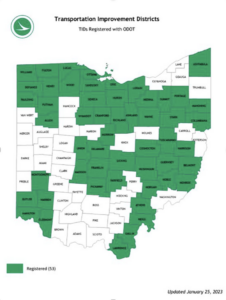
TIDs have become a mainstream tool. As of ODOT’s January 2023 statewide map, 53 of Ohio’s 88 counties had one. That is roughly 60 percent of the state. The number registered with ODOT has stayed in the low 50s in recent years, and registration matters: it is the gateway to ODOT’s dedicated TID funding round.
How is a TID formed?
A county board of commissioners creates a TID by resolution. The commissioners then set up a board of trustees under R.C. 5540.02. That board typically seats five appointed members serving two-year terms. The Speaker of the House and the Senate President may also appoint nonvoting members. To draw state dollars, the district registers with ODOT’s Office of Jobs & Commerce.
What powers does a TID have?
A TID’s authority is broad. It can finance, construct, maintain, repair, and operate streets, highways, parking facilities, and freight rail lines. It can also do the following:
- Issue revenue bonds with maturities up to 30 years.
- Levy special assessments and collect tolls or user charges.
- Acquire and dispose of property.
- Enter contracts and cross-jurisdictional agreements with neighboring counties.
A TID’s work is treated as an essential governmental function. Its financing also pairs readily with Tax Increment Financing, JEDDs, and State Infrastructure Bank loans.
When should a community consider one?
A TID is worth evaluating in three situations: when a project crosses jurisdictional lines, when growth is straining a corridor, or when one government cannot deliver a project alone. It is especially valuable as a dedicated vehicle to braid local, state, and private funding. It also helps communities compete for ODOT’s TID program, which is funded at roughly $9 million a year with awards capped at $500,000 per project per fiscal year.
For communities with a development opportunity tied to a road problem, an Ohio Transportation Improvement District can turn a stalled corridor into a shovel-ready project.
The Montrose Group has deep experience forming, administering, and lobbying for these districts. For questions, contact Tim Biggam at tbiggam@montrosegroupllc.com.