

A Republican supermajority working with Republican Ohio Governor Mike DeWine are working on a wide range of energy, state budget and economic development issues as the 136th Ohio General Assembly is up and running.
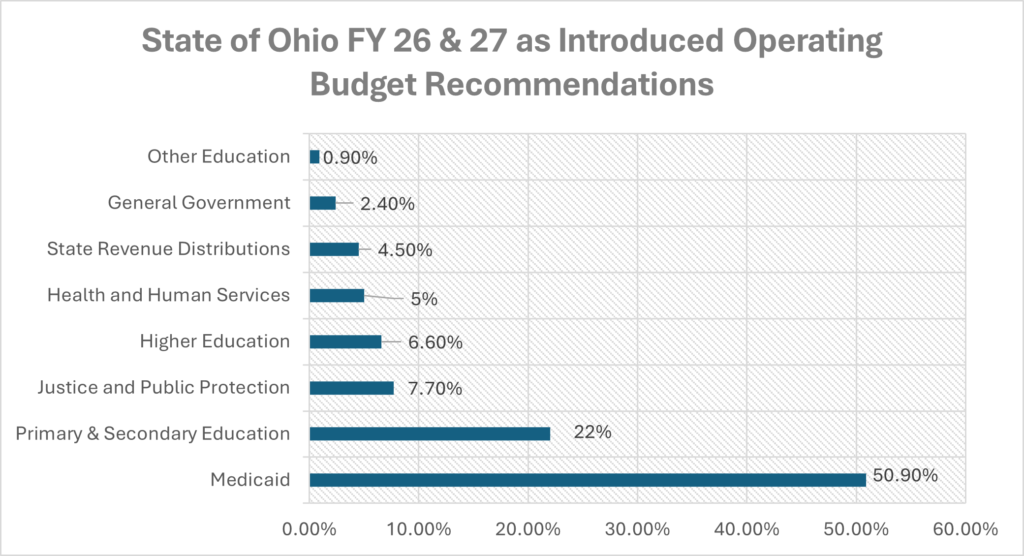
Governor Mike DeWine’s two-year operating budget is front and center in the Ohio House of Representatives with the Governor’s budget expected to be passed to the Ohio Senate in early April. 2025. Ohio Governor Mike DeWine recommended a two-year budget that totals $108.62 billion in fiscal 2026 (a 2.9 percent increase over fiscal 2025’s estimated level) and $110.70 billion in fiscal 2027 (a 1.9 percent increase over fiscal 2026’s recommended level).
The Ohio House made several policy and tax changes to HB 96 as proposed by Governor DeWine. Additional school funding formula amounts of $81,000,000 in FY 26 and $145,000,000 in FY 27, requires a County Budget Commission to reduce the property tax rates of residents within certain school districts if that district’s carry-over balance exceeds 25% of the previous fiscal years’ general fund expenditures, increases Ohio’s higher education funding through the State Share of Instruction grant by 2% in FY26 and FY27, authorizes the Ohio Treasurer of State’s office to issue and sell bonds in the amount of up to $600 million, deposited to the credit of the Cultural and Sports Facilities Building Fund administered by the Ohio Facilities Construction Commission, to help finance the Cleveland Browns stadium megaproject in the city of Brook Park, and removed DeWine proposed tax increases on marijuana, sports gaming and tobacco products.
Several popular economic development programs either were not funded in the DeWine budget or funded at lower levels. The Governor’s Budget as introduced did not fund ODOD Ohio Building Demolition, Ohio Brownfield Remediation, Ohio Residential Broadband, and Innovation Ohio Programs which were popular with economic development leaders across the state. The bill provides $100 million for the Ohio Housing Investment Opportunity Program which is planned to target infrastructure development in areas bordering metropolitan areas aka rural communities, $30.4 M for ODOT/ODOD 629 Roadwork Grant Program, $7.5 M in for Ohio Rural Industrial Park Loan Program in FY 26 and no funding in FY 27, $793,000,000 for Broadband, Equity, Access and Deployment Program in FY 26 and no funding in FY 27, removes from DeWine’s budget provisions allowing for a refundable tax credit for rehabilitation of historic owner-occupied residential property, increases the current historic building preservation rehabilitation tax credit annual cap from $60 million to $90 million, prohibits the Department of Development from using building vacancy or underutilization criteria for awarding historic rehabilitation tax credits and increases the percentage of rehabilitation costs that may be claimed as a credit from 25% to 35% for a project that is not located in Columbus, Cleveland, or Cincinnati, increases Demolition and Site Revitalization by $20 million each fiscal year for continued investment in the program, removes the sunset date for the Transformational Mixed-Use Development (TMUD) tax credit program, repeals the firm and theater capital improvement tax credit and increases the total award cap for the film and Broadway theater production tax credit to $75 million each FY, transfers $250 million from the All Ohio Future Fund to the Brownfield Remediation Fund in FY26 and increases the appropriation authority by $122,750,000 in each fiscal year to continue funding for brownfield remediation projects, and increases Rural Industrial Park Loan fund by $7,521,860 in FY27. Additionally, the bill authorizes a refundable income tax credit of up to $120,000 per project for certain owner-occupied, historic residential properties. The Governor proposed a series of sin taxes for fund specific initiatives, but those taxes are not proving popular with the Ohio General Assembly.