

Ohio data center incentives have helped make the state one of America’s premier markets for digital infrastructure. Few economic development trends are reshaping the country as fast as the data center boom. Artificial intelligence, cloud computing, and surging global demand have turned data centers into one of the most sought-after development targets, and one of the most debated.
What Is a Data Center?
A data center is a large facility that houses computer servers, data storage systems, networking equipment, and supporting infrastructure. That support includes power systems, cooling equipment, and security technology used to process, store, and transmit digital information. These facilities range from modest colocation sites to massive hyperscale campuses run by companies like Amazon Web Services, Microsoft, Google, and Meta. Notably, a hyperscale AI campus can consume as much electricity as a small city and require millions of gallons of water daily for cooling. In effect, data centers are the physical backbone of the digital economy.
A Historic Wave of National Investment
The scale of planned investment is staggering. Global data center infrastructure spending is projected to approach $3 trillion by 2030, with the United States leading the way. In 2025 alone, the six largest U.S. hyperscalers — Microsoft, Amazon, Alphabet, Oracle, Meta, and CoreWeave — spent nearly $400 billion on data center infrastructure. Spending is expected to grow by another $200 billion over the following two years. Driven by AI training and inference demand, U.S. capacity is projected to nearly double between 2025 and 2030. By 2030, analysts expect more than 2,000 new data centers worldwide, with America holding the largest share at more than 4,000 facilities as of early 2026.
The Economic Impact of Ohio Data Center Incentives
Ohio has emerged as a potential rival to Virginia’s scale. A 2025 Ohio Chamber of Commerce Foundation study found the industry contributed $11.8 billion to Ohio’s GDP in 2024. It also supported roughly 95,217 total jobs once construction, indirect, and induced employment are counted. Furthermore, data centers that received Ohio sales and use tax benefits reported a combined $27.2 billion in capital investment in 2025. Companies are projected to invest up to $40 billion more by 2030. Amazon Web Services alone has announced more than $23 billion in Ohio investment through 2030, while Google’s Ohio operations generated $21.7 billion in economic activity in 2025 and supported nearly 650,000 Ohio businesses.
State Data Center Incentives: A National Race
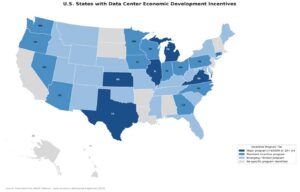
The competition among states has produced a sweeping national incentive landscape. According to the National Conference of State Legislatures, 38 states now offer dedicated data center tax incentives, up from 36 in 2024. Kansas became the 37th state to enact incentives in mid-2025. Most programs center on sales and use tax exemptions for data center equipment, power infrastructure, and, in some states, energy costs. Texas, Virginia, and Illinois lead in total subsidy volume. Ohio’s program offered a sales tax abatement for data centers investing at least $100 million and meeting an annual payroll threshold, which let the state compete aggressively across the Midwest and Southeast. Meanwhile, the twelve states without dedicated legislation risk falling behind.
Ohio’s Heated Policy Debate: The Pause and What Comes Next
Ohio’s incentive landscape shifted dramatically in late May 2026. Governor Mike DeWine directed the Ohio Tax Credit Authority to pause all new data center sales tax exemption requests effective June 1, 2026. At the same time, the Ohio General Assembly’s newly formed Joint Data Center Committee — co-chaired by Sen. Brian Chavez and Rep. Adam Holmes — began studying the industry’s full impact. The decision followed a major revenue forecasting error. The Ohio Department of Taxation had projected the exemption would cost $136 million in foregone revenue in 2025, but the actual figure reached roughly $1.5 billion.
The politics are now intense. The General Assembly had included a budget provision to terminate the exemption, which DeWine vetoed, and it is now weighing a veto override. The committee has started reviewing impacts on the electric grid, water resources, local infrastructure, tax revenue, and actual job creation. Community concerns add urgency, because Ohio consumers saw electric supply price increases of 10 to 35 percent in June 2025, partly attributed to data center demand. The Ohio Chamber of Commerce has strongly opposed the pause and warned that the state cannot afford to lose its competitive position. Ultimately, the committee’s work will define Ohio’s strategy for years and will be watched closely across the nation.
A Path Forward for Data Centers
Data centers are struggling on the public opinion front as populist opposition rises. However, a clear path remains. Projects that enter into community benefit agreements have a legitimate opportunity to move forward. Those agreements should address water and energy use, environmental permitting, noise levels, visual shielding, and compensation for impacted communities.
Contact the Montrose Group’s Dave Robinson at drobinson@montrosegroupllc.com with questions about data center public policy or economic development project negotiations.