

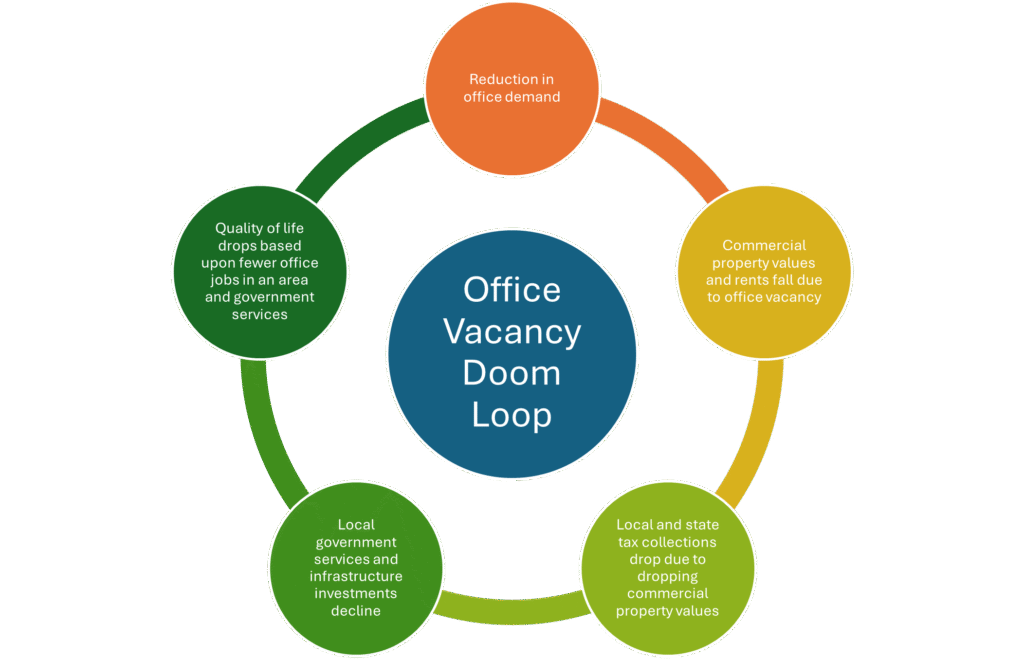
A “Doom Loop” is a downward economic spiral triggered by remote work, which makes office towers less valuable and results in reduced city tax revenues which begins a domino effect in which workers who no longer need to live in a city leave for cheaper housing, causing retail businesses to shutter and city services such as police and utilities are reduced by the cash-strapped municipality, causing even more residents to leave the downtown core. Stijn Van Nieuwerburgh is a Professor of Real Estate and Professor of Finance at Columbia University’s Graduate School of Business, and he is given credit with coining the term “Doom Loop” associated with the potential impact of the substantial office vacancy increase driven by COVID-19. The “Doom Loop” is a popular topic among business, real estate, urban planners, and local government leaders. Substantial office vacancy rates in Downtowns across America are spilling over negative impacts not just on real estate but on the communities where they reside.
The success of real estate is measured by total use inventory, rental rates, vacancy rates, absorption, and sublease requests. The total amount, usually measured by square feet of a specific use (office, residential, retail, industrial, etc….), of inventory for specific real estate use is an often-used measure of that market’s success. The rates at which inventory rents are also an important measure. The vacancy rate is the percentage of all available units in a rental property and is the opposite of the occupancy rate, which is the percentage of units in a rental property that is occupied.[i]
WFH remains a factor for companies and communities. A November, 2024 U.S. Bureau of Labor Statistics study found:
- Among employed people at work, 29.9 million teleworked in August 2023, and the telework rate, which represents the number of people who teleworked or worked at home for pay as a percentage of people who were working, was 19.5 percent in August.
- The telework rate, which is not adjusted for potential seasonal variation, has been in the range of 17.9 percent to 20.0 percent between October 2022 and August 2023.
- Among people who teleworked in August, 2023, 52.7 percent teleworked for all of their hours worked and the remaining 47.3 percent teleworked for some, but not all, of their work hours.
WFH may be becoming the new normal. The U.S. American Time Use survey data shows that in 2023, 35% of employed people did some or all of their work at home which is more than ten percentage points higher than 2019 but on par with the number from 2022.
Rents in urban centers are falling as well. A Columbia University study for the National Bureau of Economic Research found that central city rents have been in a decline. The relationship between rent growth and distance from the city center is steeply upward sloping with rents declining sharply near the center and growing rapidly far away from the center.[ii] The same pattern holds for prices.[iii] Office valuation is another series of concerns. A recent paper suggested that in New York City alone, office value destruction could total $453 billion and that values could remain around 45% below pre-pandemic levels in the long run driven by the office vacancy rate expansion.[iv]
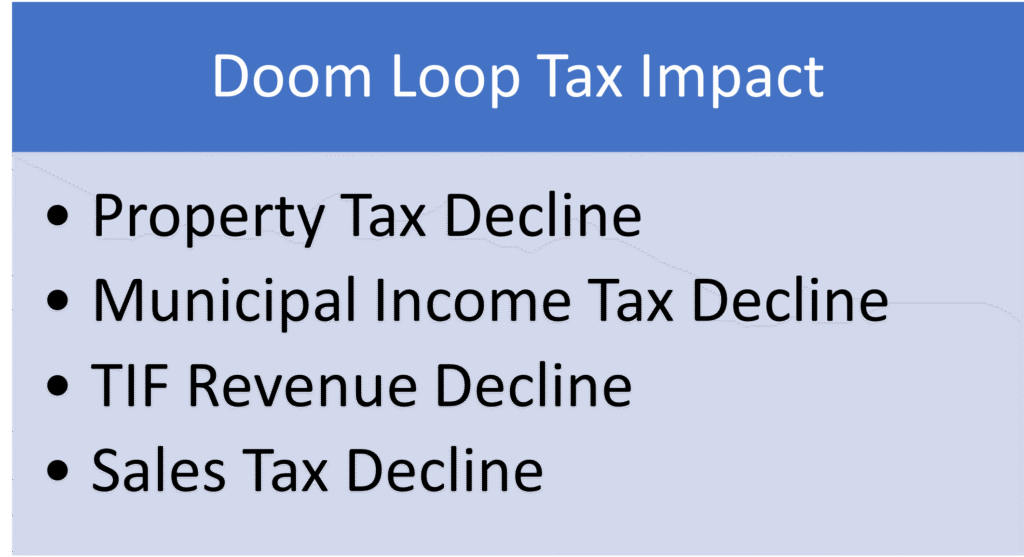
While it is too early to measure the loss in property taxes from this drop in value it will be substantial a recent New York City Comptroller report found that the estimated New York City property tax revenue shortfall relative to our current projections is $1.1 billion in FY 2027 but that constitutes only 3% of the total property tax levy, or 1.4% of City tax revenues, and 1.0% of total revenues, which include state and federal grants in the largest US office market.[v] The Tax Policy Center found that the decline in office values is projected to cost D.C. $464 million in combined tax revenue over the next three fiscal years, and San Francisco could lose $150 to $200 million annually by 2028, about 5-6% of all current property taxes.[vi] The negative impact for states that permit cities to charge a municipal income tax for those that live or work in their city such as Ohio will be harmed even more by the high office vacancy rates in the Central Business District as they will lose out on a substantial amount of income tax they collected on workers who live in suburban communities but now no longer work in the big city. In addition, the decline in property tax values that will happen with high office vacancy rates will negatively impact the collection of Payments in Lieu of Taxes (PILOTs) that provide public infrastructure revenues for economic development projects or districts through Tax Increment Financing (TIF) agreements like Downtown Columbus that has a TIF District over the entire Downtown. Sales tax is another source of government funding that will be impacted by the high office vacancy rates as the lack of office workers has a direct impact on the decline of Downtown retail and restaurants.
This associated drop in local property tax, income tax, and TIF revenues will have some unknown impact on public services unless there is enough growth and development in other parts of the city to make up for the loss in a city’s Central Business District. With the number of suburban workers in Downtown office towers it is doubtful that the revenue in other parts of the city will make up for the loss in Downtown revenue. The loss in local tax revenue and the decline of public services will impact the overall quality of life in the community. Parks, public infrastructure, police, and fire services all cost money and the Downtown which has been “cash cows” for decades for local governments and school districts will shift in their tax status—and not in a good way for Downtown neighborhoods.
[i] https://www.investopedia.com/terms/v/vacancy-rate.asp#:~:text=The%20vacancy%20rate%20is%20the,rental%20property%20that%20are%20occupied.
[ii] chrome-extension://efaidnbmnnnibpcajpcglclefindmkaj/https://www.nber.org/system/files/working_papers/w30662/w30662.pdf
[iii] Ibid.
[iv] Arpit Gupta, Vrinda Mittal, and Stijn Van Nieuwerburgh, “Work from Home and the Office Real Estate Apocalypse,” SSRN, May 15, 2023.
[v] https://comptroller.nyc.gov/reports/spotlight-what-risks-does-the-office-market-pose-for-the-citys-finances/
[vi] https://www.ioptimizerealty.com/blog/office-valuations-are-plummeting-cities-are-the-hardest-hit