

The life sciences industry is an economic bright spot across the United States. The life sciences industry consists of companies operating in the fields of pharmaceuticals, biotechnology, medical devices, biomedical technologies, nutraceuticals, cosmeceuticals, food processing, and others that dedicate their efforts to creating products to improve the lives of organisms. The life sciences industry encompasses several sectors that focus on the study of living organisms. Businesses in biotechnology, pharmaceuticals, medical devices, and other areas, develop innovations that benefit human health and play a role in agriculture, energy, and environmental industries.

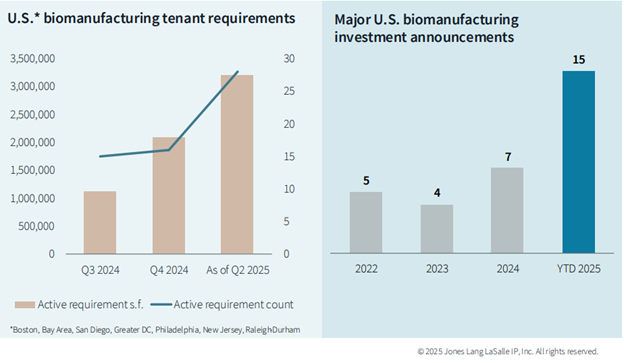
Life science companies are growing in the U.S. due to strong demand for new healthcare solutions, increased investment from venture capital, a deepening pool of skilled STEM talent, and the ongoing embrace of cutting-edge technologies like AI and machine learning to solve complex medical challenges. Favorable real estate markets offering affordable land and proximity to research centers also contribute to regional growth in specific areas. JLL reports that pharmaceutical reshoring offers a bright spot amid market challenges, with $250+ billion in U.S. biomanufacturing investments announced and touring activity for manufacturing space surge. However, the development of substantial wet lab space has created an oversupply of this speculative space, driving down rents due to an oversupply of space and lack of users.
A wide range of different markets are succeeding in efforts to attract the life science industry.
- Indiana is ranked #1 in the U.S. for pharmaceutical exports, with specific expertise in pharma manufacturing and orthopedics as they are home to the top-ranked Indiana University School of Medicine, the global headquarters of Eli Lilly & Company, and the North American Headquarters of Roche Diagnostics.
- Philadelphia is often referred to as “Cellicon Valley” based upon their success in gene and cell therapy. Its cluster is boosted by major pharmaceutical companies and the presence of world-class academic institutions like the University of Pennsylvania.
- Raleigh-Durham’s Research Triangle Park has long been a leader in the life sciences industry driven in part by their top-tier research universities, including Duke University, UNC Chapel Hill, and North Carolina State University but also through aggressive life science workforce development programs that has built a strong biomanufacturing ecosystem, with the North Carolina Biotechnology Center and NC State’s Biomanufacturing Training and Education Center (BTEC) providing key resources.
- Everything is bigger in Texas and Houston as home to the world’s largest medical complex, the Texas Medical Center, is growing in life sciences driven by talent from Rice University and the University of Houston and is attracting both funding and corporate interest.
- Chicago has long been a corporate headquarters town with its central location in the United States matched with a global airport, but the Windy City is turning into a prominent Midwest life sciences hub bolstered by a solid medical device sector and strong research and development from institutions like the University of Chicago.
- Pittsburgh is experiencing momentum, driven by its R&D sector and institutions like the University of Pittsburgh and Carnegie Mellon, and this western Pennsylvania region is attracting significant investment in medical device development and other biotech sectors.
- Finally, Columbus and the state of Ohio are making strategic investments to foster a stronger life sciences ecosystem. Ohio boasts several emerging talent clusters, with Ohio State University at the heart of the Columbus region’s growth and landed a major Amgen project that turned some heads with a $900 million expansion of its Ohio manufacturing facility, bringing the total number of jobs created to 750 and the total investment in Central Ohio to over $1.4 billion.
Life sciences corporate site location projects are often driven to communities not just with a site that fits their real estate needs but in locations with a strong life science ecosystem and a workforce ready for a new job in the life sciences industry—often with key university and community college partners.
Contact Wade Williams at wwilliams@montrosegroupllc.com if the Montrose Group can assist you with a life sciences or other corporate site location project