

The Greater Cincinnati industrial market has absorbed its new supply. The Montrose Group’s October 2026 Greater Cincinnati Industrial Outlook, using CoStar data, reports that regional industrial vacancy dropped to 3.9% from 5.1% at year-end 2025. Over the past 12 months, absorption reached 8.1 million square feet. That is well above the 10-year average of 5.1 million square feet. Meanwhile, asking rents increased 6.3% to $8.00 per square foot.
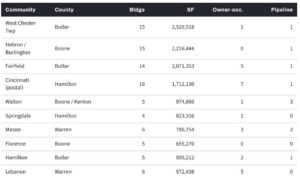
Ten communities hold about 79% of recent industrial space
A Thin Pipeline Raises the Stakes
Northern Kentucky carried about 52% of that demand. The Florence/Richwood submarket led at 2.23 million square feet, followed by the Airport submarket at 1.94 million. Since the end of 2023, Cincinnati has added 6.9 million square feet and absorbed 10.5 million. Only 1.44 million square feet is now under construction, and 98.6% of it is pre-leased. By comparison, Columbus has 24.5 million square feet underway, only 41% of it pre-leased.
With a thin pipeline, the next wave of projects will arrive as build-to-suits and expansions. Consequently, communities will compete harder for each one. That raises the stakes on every incentive decision in the Greater Cincinnati industrial market.
How Cincinnati-Area Communities Compete
Cincinnati-area communities have used a range of incentives to attract industrial investment:
- Harrison, Ohio. Harrison maintains a pre-1994 Community Reinvestment Area covering more than 900 acres of industrial and commercial land. Abatements are scaled to each project’s investment and job creation. The city also sits within an Enterprise Zone and uses its Community Improvement Corporation to advance development.
- Fairfield, Ohio. Fairfield holds one of the region’s largest recent industrial footprints: 14 buildings and about 2.1 million square feet built or planned since 2015, five of them owner-occupied. The city has paired Ohio’s local property tax tools with infrastructure investment to retain and grow manufacturers.
- Monroe, Ohio. Monroe pre-approved a 100%, 15-year CRA abatement for Park North at Monroe and Monroe Logistics Center. As a result, qualifying buildings need no separate council vote. The city also supports infrastructure through commercial and industrial TIF districts. The Monroe/Middletown submarket absorbed 1.32 million square feet over the past year and is just 1.2% vacant.
- Boone County, Kentucky. Hebron/Burlington and Florence together account for about 2.9 million square feet of recent industrial space. The Airport and Florence/Richwood submarkets lead the region in absorption, including two STORD leases totaling more than one million square feet. Boone County has combined state Kentucky Business Investment credits with local IRB and PILOT structures to compete for these users.
A Model from Central Ohio: The Pickaway County Playbook
About 100 miles to the northeast, Pickaway County shows what a coordinated, multi-pronged strategy can produce. In Harrison and Madison Townships near Rickenbacker International Airport, the county has layered four tools:
- A 100% CRA abatement. The Northern Industrial CRA offers 100%, 15-year real property tax exemptions. In May 2026, commissioners approved one for Core5 Industrial Partners’ $147.7 million, 2.69 million-square-foot project in Madison Township.
- Construction materials sales tax exemption. To qualify for the CRA abatement, projects must run construction materials purchases through the Pickaway County Port Authority’s sales tax exemption program, or make a one-time payment equal to 25% of the avoided tax. Developers save 50% to 75% of the sales tax on materials, and the Port Authority gains a revenue stream.
- Tax increment financing. A 30-year TIF for Coyne Rickenbacker’s roughly 680-acre site in Harrison Township authorizes up to $47.5 million in public infrastructure reimbursement. It supports an estimated $500 million or more in investment and about 2,000 jobs.
- A Joint Economic Development District. A 2006 JEDD between Columbus and Pickaway County jurisdictions extended water, sewer and roads to the area. Today, revenue from the Madison Township JEDD helps fund public services, including new fire engines for the Harrison Township Division of Fire.
The results are visible. The Pickaway County submarket now has about 4.6 million square feet under construction, equal to 21.6% of its existing inventory. Because the JEDD site had already been readied for development, Anduril was able to move quickly on Arsenal-1. That five-million-square-foot advanced manufacturing campus is expected to bring more than 4,000 jobs and over $900 million in investment. The state calls it the largest single job creation and new payroll project in Ohio’s history.
What It Means for the Greater Cincinnati Industrial Market
Cincinnati communities already carry a large industrial footprint: 120 industrial buildings of 50,000 square feet or more built or planned since 2015 across eight counties. As those buildings lease, sell and expand, communities must manage existing commitments while competing for scarce new projects. Pickaway County’s lesson is that incentives work best as a coordinated package. Abatement, infrastructure finance, a revenue-sharing structure and site readiness should be aligned well before a major prospect arrives.
The Montrose Group helps communities and developers structure the incentives and public-private partnerships that attract industrial investment. Contact Wade Williams, Director of Corporate Site Selection Services, at wwilliams@montrosegroupllc.com for a confidential review.