

A brownfield is a property, the expansion, redevelopment, or reuse of which may be complicated by the presence or potential presence of a hazardous substance, pollutant, or contaminant. According to the U.S. Environmental Protection Agency (US EPA), there are more than 450,000 brownfields in the U.S. Cleaning up and reinvesting in these properties increases local tax bases, facilitates job growth, utilizes existing infrastructure, takes development pressures off of undeveloped, open land, and both improves and protects the environment.
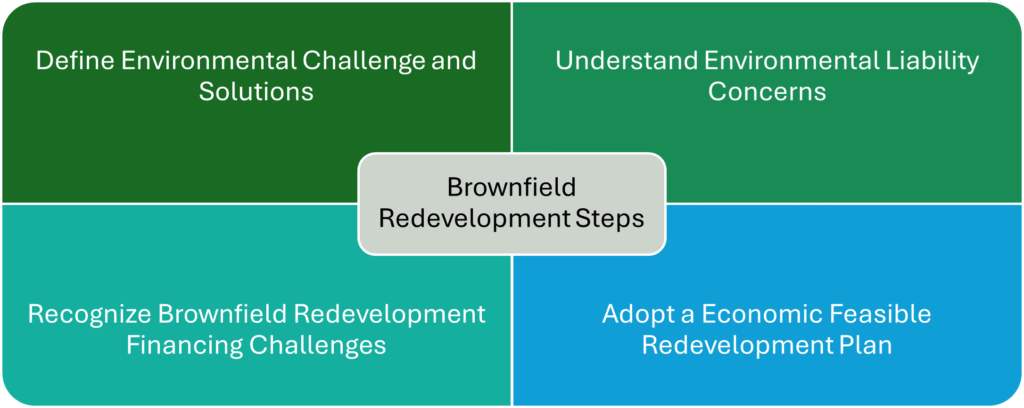
Tackling an adaptive reuse strategy such as redeveloping a Brownfield site require a thoughtful strategy that recognizes the potential challenges of the site. Several challenges make brownfields cleanup and redevelopment unique compared to other real estate development projects.
These challenges include:
- Environmental Liability Concerns. Developers and property owners want to manage past and future liabilities associated with the property’s environmental history.
- Financial Barriers. Private lenders are reluctant to give loans for potentially impaired lands. In some cases, cleanup costs for a property may ultimately be more than the property’s value.
- Cleanup Considerations. A brownfields redevelopment timeline may take longer than typical real estate development due to environmental assessment and cleanup activities.
- Reuse Planning. A reuse plan based on community goals or sound economic and environmental information (e.g., market potential) may be lacking.
Government funding is an essential aspect of redeveloping a Brownfield site. The costs of environmental remediation generally dictate a public subsidy to create an economically competitive site.
Federal government Brownfield grants and loans can be an important funding source for Brownfield redevelopment programs. Brownfields grants continue to serve as the foundation of US EPA’s Brownfields Program. These grants support revitalization efforts by funding environmental assessment, cleanup, and job training activities.
- Brownfields Assessment Grants provide funding for Brownfields inventories, planning, environmental assessments, and community outreach.
- Brownfields Revolving Loan Fund Grants provide funding to capitalize loans that are used to clean up Brownfields.
- Brownfields Job Training Grants provide environmental training for residents of Brownfields communities.
- Brownfields Cleanup Grants provide direct funding for cleanup activities at certain properties with planned greenspace, recreational, or other nonprofit uses.
- Brownfields Area-Wide Planning Grants provide funding to communities to research, plan and develop implementation strategies for cleaning up and revitalizing a specific area affected by one or more brownfields sites.
State governments also offer critical Brownfield redevelopment grant programs. The Ohio Brownfield Remediation Program provides grants for the cleanup of brownfield sites, to assist in the remediation of hazardous substances or petroleum at an industrial, commercial, or institutional property. Remediation includes the acquisition of a brownfield, demolition performed at a brownfield, and the installation or upgrade of the minimum amount of infrastructure necessary to make a brownfield site operational for economic development activity. The Ohio General Assembly awarded $200 million to the state of Ohio Brownfield Remediation Program. The Ohio Brownfield Remediation Program has been altered to broaden eligibility and scope while changing how funds are awarded. Previously, the old system designated a single “lead entity” for each county to funnel all applications, has been eliminated. Now, a wider range of organizations, including counties, townships, municipal corporations, port authorities, park districts, county land reutilization corporations, and for-profit organizations can apply directly. The definition of “remediation” has been expanded to include acquisition, demolition, and infrastructure costs to include the installation or upgrade of the minimum infrastructure necessary to make a brownfield operational for economic development (no longer capped at 10% of total project cost), and “site control” is defined as holding fee simple title or a leasehold interest in a brownfield or being in contract to acquire a brownfield. Starting in 2027, the Ohio Brownfield Program eliminates the requirement that money not reserved for each county under continuing law be available for grants located anywhere in the state on a first come, first-served basis; and, instead, starting in FY 2027, requires any funds appropriated and any money reserved from an appropriation that is not utilized to be awarded on a case by case basis with the ODOD evaluating the economic merit of the project, when making an award determination, to the county, surrounding counties, and state, and requires ODOD to ensure that projects are not specific to one region of the state. The program will continue to have a $1 million per county set-aside, and once the initial county set-aside period ends, the remaining funds will be awarded based on a competitive “economic merit” evaluation rather than on a first-come, first-served basis.
Brownfields require a public subsidy to redevelop, and federal and state programs offer this critical public support to spur a rebirth of these sites.
Contact Dave Robinson at drobinson@montrosegroupllc.com if you need any assistance with a Brownfield redevelopment project.