

America’s electricity future tends to focus on generation, but an electric transmission bottleneck is the real constraint on growth. Even where new power gets built, it cannot reach customers without wires, substations, and transformers.
How the electric transmission bottleneck formed
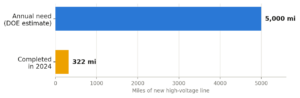
The United States underbuilt transmission for a generation. The DOE estimates the country needs roughly 5,000 miles of new high-capacity transmission line each year to keep pace with demand. In 2024, only about 322 miles of new high-voltage line were completed.
The backlog shows the strain. More than 2,600 GW of generation and storage projects sit in interconnection queues. That is more than double the nation’s installed capacity, all waiting because the grid cannot carry the power.
The equipment supply chain
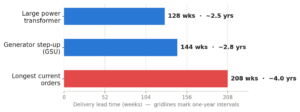
The deeper problem is hardware. Transformers step voltage up for transmission and down for distribution, and they are in acute shortage. Consider the numbers:
- Lead times for large power transformers now run two to four years.
- Generator step-up units average roughly 144 weeks.
- Prices have climbed about 80 percent in five years.
- Demand for some categories has grown 274 percent since 2019.
- Roughly 80 percent of U.S. large power transformers are imported.
The bottlenecks trace to grain-oriented electrical steel, copper windings, skilled labor, and customization that resists mass production. Switchgear and breakers face similar strain.
For companies, the lesson is blunt: equipment procurement must now precede project approval, not follow it. In fact, many developers are buying factory production slots before a site is even finalized.
How governments are easing the bottleneck
The fastest fixes squeeze more out of existing corridors.
Federal fixes
Federal policy has pivoted toward advanced transmission technologies. These include reconductoring lines with higher-capacity advanced conductors, dynamic line rating, and power-flow control. Each can add capacity in months without new rights-of-way. The DOE’s $1.9 billion SPARK program funds exactly these upgrades. The bipartisan REWIRE Act would go further, creating a NEPA categorical exclusion for capacity gains within existing corridors and improving FERC returns on reconductoring.
State and local action
States are doing their part through grid “heat maps,” advanced-technology mandates, and faster siting. Ohio’s House Bill 15 is one example. Locally, governments can pre-position sites, streamline permitting for substations and lines, and use TIDs, JEDDs, and TIF to underwrite the access and site work these projects require.
Recruiting the manufacturers
Here is the economic development opportunity. The same shortage is triggering the largest factory buildout the sector has seen in decades. Manufacturers have committed roughly $2 billion to new U.S. transformer capacity since 2023, with plants announced or expanding in Virginia, the Carolinas, Tennessee, Texas, and Alabama.
Communities that move now can compete for these facilities. The recruitment playbook is familiar:
- Assemble shovel-ready industrial sites with rail and heavy power already in place.
- Build pipelines for the skilled winding and assembly labor these plants need, often through community colleges.
- Pair state incentives with local tools.
A transformer plant is a durable, high-wage anchor. Better still, reshoring policy and tariffs now tilt the field toward domestic production.
The communities that treat the electric transmission bottleneck as a recruiting opportunity, not just an obstacle, will capture both the jobs and the reliability.
The Montrose Group is actively engaged with government and industry leaders to address the transmission and distribution investment gap that is slowing economic growth.