

Historic Preservation Tax Credit Drives Adaptive Reuse and Economic Growth
For nearly 50 years, the Federal Historic Preservation Tax Credit program — commonly called the Historic Tax Credit (HTC) — has quietly transformed abandoned factories, empty schools, and historic downtown storefronts into thriving economic hubs. It is a proven, cost-effective partnership between private investors and the public sector, demonstrating that preserving our heritage is also a powerful engine for economic growth.

How the Historic Tax Credit Works
Established in 1976, the HTC provides a 20% federal tax credit to property owners who substantially rehabilitate a certified historic building while preserving its historic character. The program is administered by the National Park Service (NPS) and the IRS, in partnership with State Historic Preservation Offices (SHPOs), and applies to income-producing properties including commercial, office, residential rental, and industrial buildings.
Program Impact by the Numbers
The Historic Tax Credit’s track record speaks for itself. Since inception through FY 2024, the program has:
- Leveraged over $257 billion in private investment
- Rehabilitated more than 50,000 historic properties nationwide
- Created over 3.4 million jobs
These projects are frequently located in distressed areas, serving as a vital catalyst for community redevelopment — often bridging the financing gap between the cost of complex rehabilitation and long-term return on investment. In FY 2025 alone, developers secured $8.64 billion in HTC investments, the second-highest annual total in the program’s history.
Why the HTC Works
The Historic Tax Credit delivers a broad range of policy, real estate, and economic development benefits:
- Creates local construction and professional service jobs
- Rehabilitates housing units, with a significant share serving low- and moderate-income residents
- Reduces demolition waste and consumes less energy than new construction, making it an eco-friendly investment
- Generates more in federal tax revenue over the life of a project than the credit costs
State Historic Tax Credit Programs
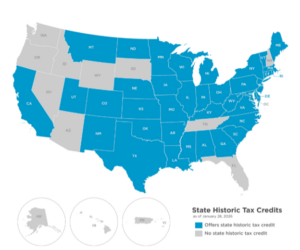
More than 70% of U.S. states offer a complementary state historic preservation tax credit. These programs typically cover 20–25% of qualified rehabilitation expenditures (QREs) and require properties to be listed on or eligible for the National Register of Historic Places.
State credits are generally:
- Applied to income-producing, commercially certified projects approved by the state SHPO
- Calculated as a percentage of construction costs — Ohio’s credit covers 25% of qualified costs
- Competitively awarded and usable against income, insurance premium, or financial institution taxes
- Stackable with the 20% federal HTC, creating a powerful combined incentive
Some states offer higher percentages for rural projects or affordable housing, and many allow credits to be transferred or sold.
A Proven Tool for Community Revitalization
From the rehabilitation of midcentury apartment towers in Florida to the revival of industrial complexes in Ohio, the Historic Tax Credit continues to breathe new life into neglected sites. When stacked with programs like the New Markets Tax Credit or Opportunity Zone incentives, it becomes one of the most powerful financing tools available for transforming distressed communities into lasting economic assets.