

In the shadow of a potential ballot initiative that would eliminate nearly $30 billion in Ohio property taxes, the Ohio General Assembly is working to address the rising property tax burden on Ohio taxpayers.
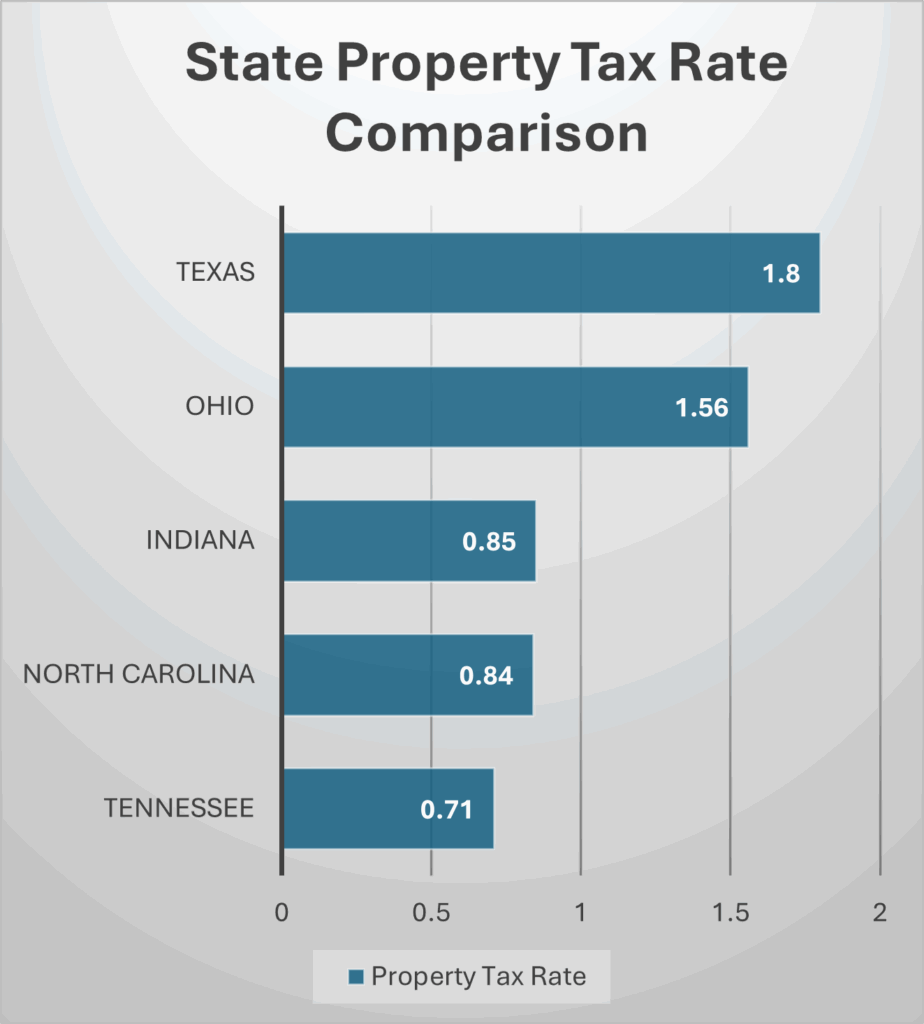 Ohioans, while paying income, sales, capital gains, property tax and other taxes face a property tax rate that is nearly double that of neighboring states like Indiana and Kentucky. As the chart illustrates, states like Texas have a higher effective property tax rate than Ohio but the Lone Star state does not have a state or municipal income tax. Ohio’s traditional public school districts, social service agencies, transit agencies, and townships almost rely exclusively on property taxes to operate while cities, counties, and state government have a smaller portion of the property tax that makes up their overall funding scheme. A citizen lead group is working on placing an Ohio Constitutional Amendment to eliminate the property tax. Media reports indicate they have over 100,000 of the 415,000 valid signatures required for the ballot initiative. For initiated constitutional amendments in Ohio, valid signatures of registered voters are required from at least 10% of the total vote cast for governor in the last election, and, within each of the 44 counties, the number of signatures must equal at least 5% of the county’s gubernatorial vote from the same election.
The Ohio House continued its effort to reduce the property tax burden of Ohio homeowners, passing two measures out of the chamber in bipartisan fashion. HB 186 would limit school districts’ property tax revenue growth, and HB 335 would cap revenue increases tied to inside millage to the rate of inflation. HB 186 is working to hold school districts whole by providing almost $500 million in state funding from the Expanded Sales Tax Holiday Fund. The appropriation guarantees school districts in counties that underwent a reappraisal or triennial update in Tax Years 2023 and 2024 will receive the same amount of revenue as in Tax Year 2024.
The House’s bipartisan advancement of those property tax measures also included a provision ensuring districts receive the same amount of funding as they did in Tax Year 2024.
These bills are now being heard in the Ohio Senate and passage may happen in a matter of weeks primarily designed to discourage the property tax elimination amendment from gathering the support it needs to make it to the ballot. Most associations representing schools, local governments and taxpayer groups spoke highly of the House’s action in passing property tax reform legislation. Time will tell if the voters faced with an opportunity to eliminate the Ohio property tax will see these measures as enough.
Contact Tim Biggam if you need assistance with any lobbying matter at the Ohio Statehouse at tbiggam@montrosegroupllc.com.