

The United States is several years into an energy crisis—not the kind of the 1970s that creates long lines for consumers to get gasoline but instead a long line for large scale manufacturing, technology and data centers to get a near term commitment for the delivery of critical electricity.
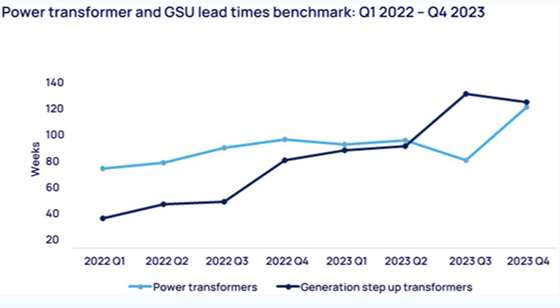
In the last several years, the distribution of electric power directly to customers has been suffering from substantial delay times in the delivery of these services as outlined by the chart below from Grid Strategies. Lead times for the delivery of and installation of transformers needed to take power off electric transmission lines and connected to major industrial customers often takes over 100 weeks to well over 200 weeks for larger transformers which have a negative impact on economic development projects in need of electric services.
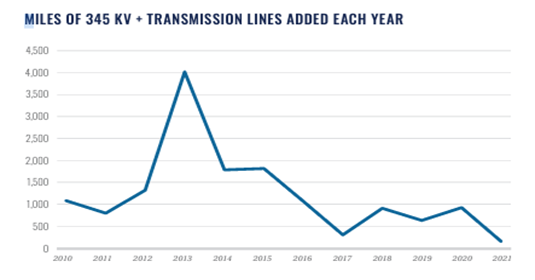
Construction of new high-voltage transmission lines significantly slowed in the U.S. over the last dozen years, according to FERC’s monthly Energy Infrastructure Updates. The U.S. dropped from installing an average of 1,700 miles of new high-voltage transmission miles per year in the first half of the 2010s, to averaging only 645 miles per year in the second half of the 2010s.
At the exact time of disinvestment and supply chain challenges in the electric distribution and transmission system, data centers have the potential to double their energy usage by 2026, according to a recent International Energy Agency (IEA) report. IEA forecasts that data centers’ total electricity consumption could reach more than 1,000 terawatt-hours (TWh) in 2026 with the electricity demand for data centers driven by new Artificial Intelligence (AI) applications equal to the energy consumption of Japan. In 2022, 460 terawatt-hours (TWh) were consumed by data centers, representing 2% of all global electricity usage—that amount is expected to jump to 6% by 2030. The share of U.S. electricity consumed in the transportation sector is also increasing as electric vehicles enter the marketplace. Due to the rise in electrification, PJM is forecasting significant long-term and medium-term load increases – more than 40,000 MW in the next 15 years. At the exact time that electricity demand is dramatically on the rise, public policymakers are driving a transition of the U.S. sources of energy award from fossil fuels to renewable sources that generally cannot produce the base load power needed for data centers and heavy manufacturing. Generating additional base load power is a critical issue for federal and state policymakers to address to capture an AI economic benefit.
States across the U.S. are in an “arms race” to address this 21st Century Energy Crisis. Ohio enacted Ohio House Bill 15 to spur additional merchant energy production that included removing the investor-owned utility from energy production, reducing taxes on new energy production facilities and streamlining regulation on the same. Texas is spending $5 billion to spur the production of natural gas facilities to generate electricity. The reality is new large scale industrial developments are planning to develop their own on-site power in the near term all across the United States and often they may turn to the use of Small Modular nuclear Reactors (SMRs) to do so.
To support greater energy production, Ohio Governor Mike DeWine and JobsOhio announced the creation of the new JobsOhio Energy Opportunity Initiative, a $100 million fund for economic development opportunities over a five-year period. These funds will aid qualifying companies in the form of grants and low-interest loans to help offset costs related to natural gas and nuclear power production in Ohio.
Funds from the Energy Opportunity Initiative will be used over a five-year period and focus on:
- Engineering, right-of-way, and construction costs for new and existing natural gas infrastructure
- Site preparation for SMR generation
- Advanced training for Ohio’s workforce and the creation of a “nuclear energy center of excellence” around employment
- Incentives for attracting supply-chain companies for SMR manufacturing and production
JobsOhio will work with its seven regional network partners to identify projects and companies that could benefit from the Energy Opportunity Initiative. This initiative will be leveraged for attraction and expansion projects throughout the state. States across the country are seeing an increase in energy demand. Ohio has abundant natural gas, which is why investments in Ohio’s shale-energy sector have soared past $111 billion since 2011. States that lack this natural resource are instead quickly pursuing newer technologies around nuclear power, including nuclear fission small modular reactors (SMRs). Ohio will need to tap into both capabilities to help businesses grow and thrive and create jobs for Ohio families. Natural gas infrastructure and SMR development are expensive but essential for Ohio to continue as a U.S. energy leader.
No state has solved the energy crisis but those that do will benefit substantially from a new generation of economic investment.
Please contact Dave Robinson if you need any assistance in gaining energy infrastructure funding at drobinson@montrosegroupllc.com.