

Life science manufacturing facilities are not “your father’s factory.” The manufacturing of pharmaceutical and biotechnology products is a highly scientific endeavor and requires compliance with a wide range of federal regulations. The workforce required for these facilities is very different from that of an auto assembly plant.
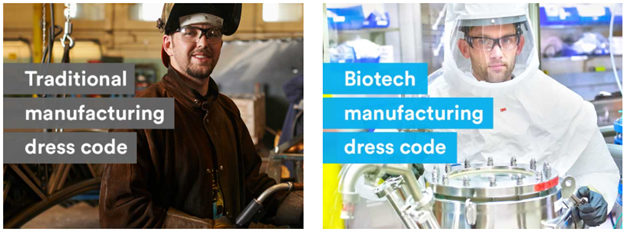
Key occupations of a biotech manufacturing center include:
- Manufacturing Technician/Operator: Runs and maintains production equipment and processes, monitors product quality, and documents procedures.
- Packaging Operator: Is responsible for packaging finished products according to company and industry standards for distribution and sale.
- Production Supervisor: Oversees the production floor, including staff, equipment, and processes, and handles routine production activities.
- Manufacturing Associate/Assembler: Involved in the assembly and production of products, often working with specific equipment and processes.
- Fabrication Technician: Specializes in the technical aspects of building and assembling components and equipment within the life sciences manufacturing environment.
- Bioprocess Operator: Works in bioprocessing environments, handling and manipulating biological materials and processes for product development and manufacturing.
Life sciences industry occupations is going to see substantial growth in the near future. The federal Bureau of Labor Statistics estimates that overall employment in life, physical, and social science occupations is projected to grow faster than the average for all occupations from 2024 to 2034. About 144,700 openings are projected each year, on average, in these occupations due to employment growth and the need to replace workers who leave these occupations permanently. These are also very high wage jobs– the median annual wage for this group was $78,980 in May 2024, which was higher than the median annual wage for all occupations of $49,500.
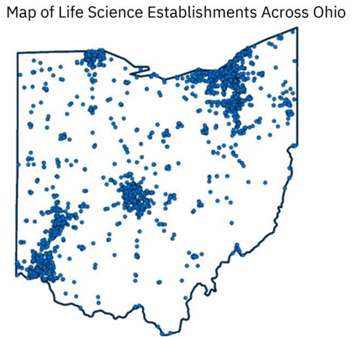
Many states are following the path of the Research Triangle Park in using workforce development strategies to attract life sciences companies. Ohio offers the newest example of an aggressive workforce development program being the “point of the spear” for their life sciences corporate site location strategy. JobsOhio, in partnership with the Ohio Life Sciences Association (OLS) and One Columbus, announced a biomanufacturing workforce initiative designed to train Ohioans for operator and technician roles in pharmaceutical manufacturing and related careers in biotechnology. To bolster the state’s existing pipeline of highly skilled, industrious workers—and to move at the fast pace necessary to meet this increase in demand—JobsOhio plans to work with industry companies to invest up to $30 million over five years to build a new state-of-the-art training center in central Ohio. The facility will include labs, simulated clean rooms, and a classroom, and will offer expanded programming designed to prepare students for a career in pharmaceutical biomanufacturing. OLS will oversee operations and collaborate with Ohio higher education institutions to deliver curricula. The ultimate goal is to create a “hub and spoke” program via a network of community colleges and technical schools throughout Ohio to meet employment needs in all parts of the state.
Workforce development is a critical factor life sciences companies consider when choosing where to locate their high wage jobs and make millions of dollars in capital investments. States engaged in preparing the life science workforce for these jobs before they land in a state have a substantial leg up on the competition.
If you need assistance with a life sciences or other corporate site location project or are a local community looking to attract this industry contact Wade Williams of the Montrose Group at wwilliams@montrosegroupllc.com.