

JobsOhio has led an economic revival in the state of Ohio, but legislation introduced in the Ohio House of Representatives is likely to kill the economic development momentum created by the state.
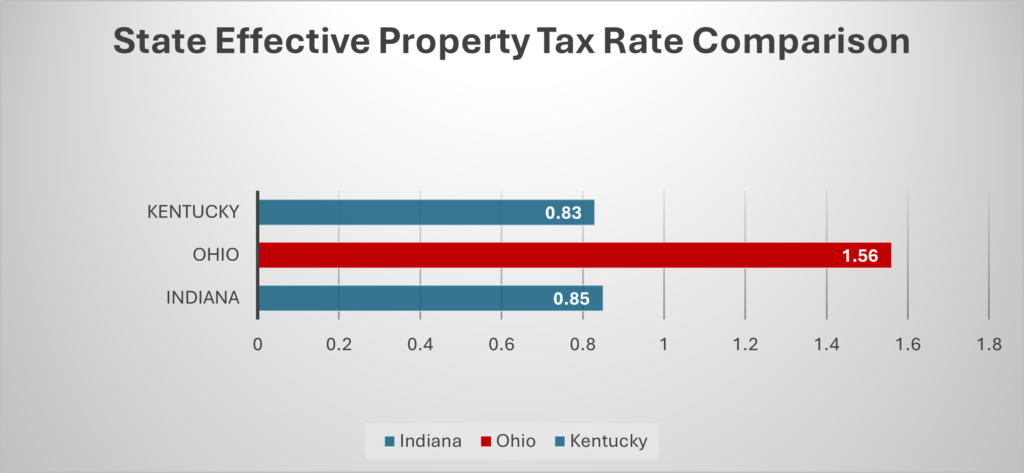
Ohio’s rising property tax rates are a result of increasing local, often voter approved, property tax rate increases, the growth of property taxes from non-voted inside millage, and a lack of housing new housing supply which is driving home prices through the roof. In fact, as outlined below, Ohio’s effective property tax rate is nearly double competitor states.
A prime method to address rising property tax rates is to increase the supply of housing in a market. Ohio, like many regions, is far behind in the development of new housing. Ohio is fortunate to have a range of tools such as the Type II annexation, Community Reinvestment Area (CRA) real property tax abatement and Tax Increment Financing (TIF) programs that address rising property taxes and provide an incentive to develop housing. Ohio has five methods to annex land from a township to a city—annexation occurs generally when a private property owner wishes to gain access to public services such as water, sewer, and roads that cities have and small, rural townships do not. Type II annexation was designed to be a streamlined method of bringing land into cities as it is driven by a petition from the property owner. Approval is generally automatic at the local level as the owner of the property has a right to develop their land and decide if they want to pay higher taxes in exchange for services in a city as compared to a township. CRAs can be enacted by cities and counties to provide up to a 75% for 15 real property tax abatement for housing and commercial projects without local school board approvals. However, many CRA agreements also provide compensation agreements to the local school districts that provide a revenue stream to schools that may not be counted as “revenue” for purposes of the state’s school funding formula. TIFs capture future real and personal property tax revenue generally for use on public infrastructure. Again, TIFs require local school board approval if they are for 75% for more than 10 years. CRAs and TIFs are critical tools for the development of the new housing supply that is the key to reducing property tax.
Two Ohio House bills recently introduced are putting Ohio’s economic development incentive program designed to spur more housing in jeopardy. Ohio House Bill 113 and Ohio House Bill 154 would require school board approval for all CRAs and TIFs ensuring that many economic development projects will not happen as often local schools oppose these projects.
Ohio State Representative Adam Bird has introduced Ohio House Bill 113. HB 113 does the following:
- Requires an expedited annexation or a municipality-initiated annexation to serve the
general good, as determined by the board of county commissioners.
- Modifies various aspects of the expedited type 2 annexation procedure, including the
following: requires the annexed territory to remain in the township only if the township
provides services to the territory, reduces, from 500 to 200, the maximum acreage of the territory proposed for annexation, increases, from 5% to 20%, the amount of a contiguous boundary the municipal corporation must share with the territory proposed for annexation, requires the State Board of Education to transfer territory annexed by a municipal corporation under an expedited type 2 annexation to the city, local, or exempted village school district that primarily serves the municipal corporation to which territory is annexed, requires the school district from which the territory is transferred to permit students living in the transferred territory who previously enrolled in the district in the 9th grade or higher to re-enroll in the district under the district’s open enrollment policy until the student completes the 12th grade.
- Requires cities managers, assistant city managers, village administrators, and assistant village administrators to file a financial disclosure statement.
- Extends school board approval requirements to residential improvements in community reinvestment areas.
These troubling changes to Ohio’s annexation and CRA tax abatement program would result in major economic development projects dying a slow death before local school boards and county commissioners.
State Representative Dave Thomas has introduced Ohio House Bill 154. Representative Thomas’ bill would change Ohio law to requires school district approval of residential community reinvestment area property tax exemptions. As school districts across the state often publicly oppose residential development because they will produce students for their schools, this legislation will have a negative impact on not just industrial growth but also residential development—just at the time when Ohio needs more residential development.
Representatives Bird and Thomas are both respected members of the Ohio General Assembly, but their legislation will have a dramatic impact on how local governments impact the creation of high-wage jobs and capital investment as well as spur residential development.