

Housing is a critical corporate site location factor for communities across the nation, but the supply of housing in growing regions as well as rural communities is simply not meeting the demand and putting major corporate site location victories in jeopardy. States seeking to increase their housing supply can drive this growth with state public policy decisions focused on developing sites, addressing regulatory and tax hurdles, providing housing financing and local, state and federal housing incentives.
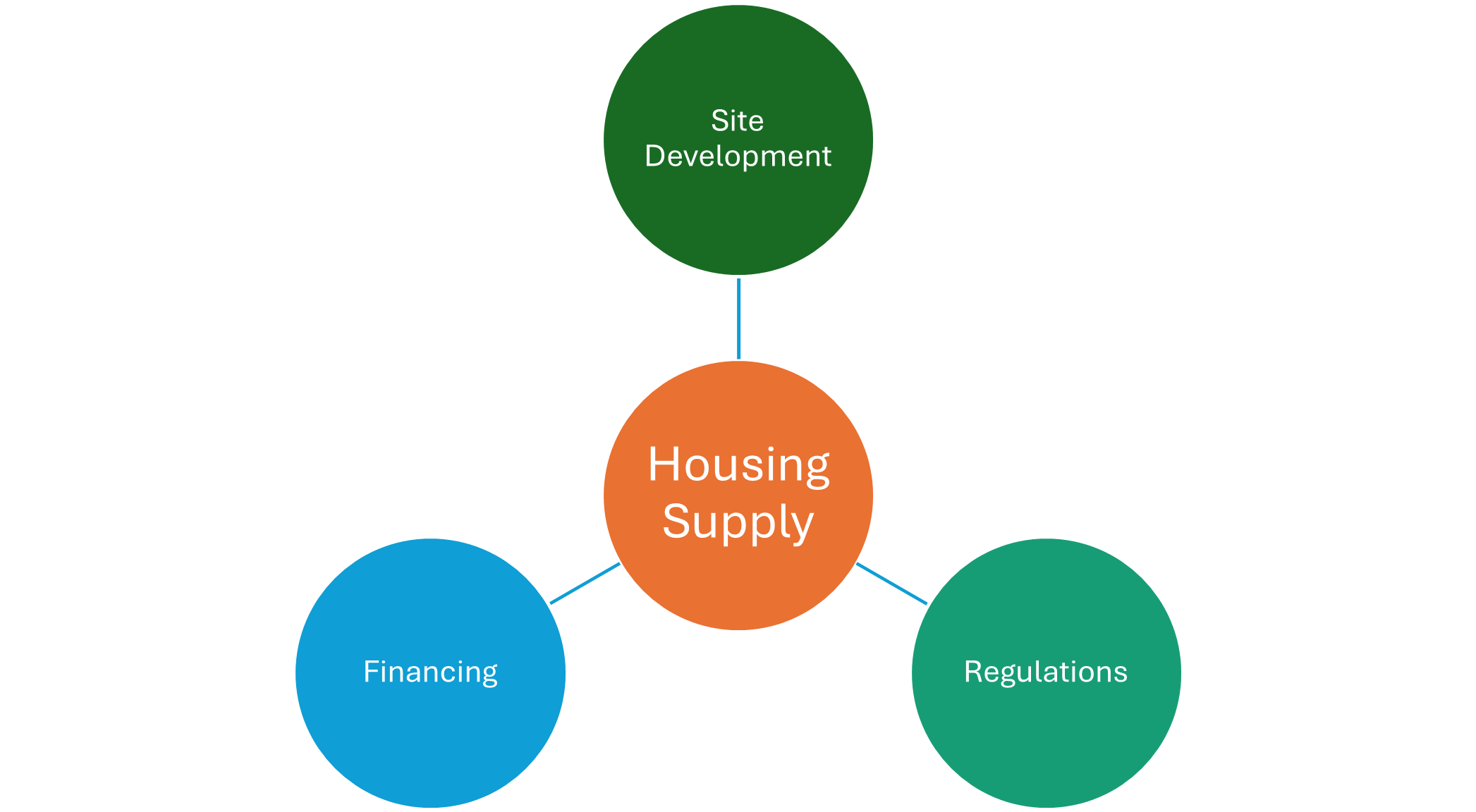
States across the nation illustrate strategies designed to foster the growth of housing supply built around site development, regulations and taxes, financing, and local, state and federal housing incentives, and new public policy ideas can impact the development of sites, reduction of regulation for housing development, and financing of projects through tax credits, loans and economic development incentives. Below are state strategies geared toward addressing the lack of housing supply.
Site Development.
- The Welcome Home Ohio Program provides $150 M for grants up to $30,000 through local land banks to purchase residential property for the development of income-eligible owner occupied single-family homes.
- A Rural Housing Development Loan Program could be created and modeled after the successful Ohio Rural Industrial Park Loan Program by providing low-interest direct loans to assist eligible applicants in financing the development and improvement of industrial parks and related off-site public infrastructure improvements.
- Indiana provides Comprehensive Land Use Planning Grants designed to aid communities in evaluating assets and identifying opportunities to address current needs in the following areas: land use, government capacity, public services, placemaking, economic development, housing, transportation, agriculture, natural resources, broadband access, and historic resources where applicants with a population over 10,000 may request up to $60,000, and applicants with a population under 10,000 may request up to $50,000.
- Michigan’s Housing Readiness Program which provides grants for eligible activities including costs associated with the adoption of land use policies, master plan updates, zoning text amendments, and similar actions to encourage increasing housing supply and affordability.
- Virginia requires plans for residential developments tied to planned industrial parks for their site certification program to illustrate how residential development will keep up with planned job growth.
Regulations.
- Indiana, Texas and Tennessee do not permit local zoning referendums while states like Ohio do.
- Indiana permits adjacent cities to conduct land use planning and zoning for adjacent townships and states like Ohio that permit even small rural townships with no paid staff to control zoning could require County Commissioners to administer zoning regulations for non-Home Rule townships.
- Ohio has a range of annexation processes, but it could be streamlined for property owners who are seeking to annex into a city by setting an automatic 30 day approval process by County Commissioners.
- California and Florida created programs to permit residential development on sites currently zoned and designated for commercial or retail uses as a matter of right residential development where land is zoned for retail requiring specific density, set back, parking, environmental, signage, and other state of Ohio land use requirements developed based upon the guidance of local governments, require local governments provide an architectural review approval as is done for new land uses in places like Downtown Columbus, Ohio.
- States could address the growth of property taxes by capping the growth of inside property tax millage in states like Ohio to a set amount, and capping property tax growth through local voted levies.
Financing and Local, State and Federal Government Housing Incentives.
- Federal and state legislation could support the conversion of office space into residential development creating an office conversion tax credit for commercial office buildings built at least 25 years before their conversion.
- Ohio’s Transformational Mixed Use District Program provides an assignable tax credit up to 10% of development costs that needs to be renewed and increase the tax credit spending cap to $400 M annually to spur residential development.
- Indiana’s Redevelopment Tax Credit provides an assignable tax credit to redevelop vacant or underutilized land and buildings to cover up to 30% of the permitted costs.
- Create a state density bonus program like California and Oregon but provide funding for public infrastructure funding for communities that adopt the density bonus guidelines for residential development.
- Increase the number of credits available through the state Low Income Housing Tax Credit Program up to and extend the program through FY2031.
- Increase funding for state Single-Family Housing Tax Credit Programs that leverages public-private partnerships to increase the inventory of affordable, single-family housing for a minimum of five, single-family dwellings to be constructed or blighted structures to be made habitable to be sold to a qualified buyer.
- Indiana expands the use of their state historic presentation tax credit with $50 M in annual funding and new markets tax credits for $100 M in annual funding that can be used for residential development.
- States like Ohio and Indiana permit the use of tax increment financing to cover the cost of public infrastructure for residential and commercial projects.
- States like Ohio permit the use of a Community Reinvestment Area tax abatement for residential development without local school board approval.