

The lack of housing supply is driving up property tax rates having a negative impact on current residents and new companies considering markets for economic investments.
The accounting firm Novogradac reports that the recent production rate of homes is much slower than the historical norms. Starting in the mid-1970s, the housing construction industry built on average 130 new units for every 100 households formed. This ratio has been used as the rule of thumb by the Harvard Joint Center for Housing Studies in determining the appropriate amount of construction required to ensure housing needs are met. This ratio is the rule of thumb to account for changes of population in markets, the natural amount of vacancy that is required for a healthy housing market and for the replacement of housing units that happens due to conversion or demolition. From 2010-2018, the actual ratio got smaller, as 8.35 million households were created during this time frame and only 8.35 million new housing units were built–including housing completions and placements of manufactured homes.
The rising property taxes directly impact existing homeowners and residential renters. Property tax assessments are driven by a comparison of housing values of like properties—which comes from a comparison like property sales. A lack of housing supply driving up the residential purchase price drives up the value of the homeowner next door—even if they are low-income residents. According to a recent analysis by the Minneapolis Fed, property taxes account for a rising share of the average American housing budget—almost 17 percent in 2021 for homeowners with a mortgage. In the City of Chicago, taxes on properties in 2021 rose 6.6 percent compared to the previous year according to the Cook County Treasurer. Property taxes are often a much larger burden on lower-income families than wealthier households. The Institute on Taxation and Economic Policy found that in 2018, the poorest 20 percent of taxpayers paid 4.2 percent of their income on property taxes, compared to 3 percent of income for middle-income taxpayers and 1.7 percent of income for the wealthiest 1 percent of households. Other research has found that these tax disparities are felt strongest by Black and Hispanic residents who are estimated to have a 10 to 13 percent higher property tax burden than households more generally. A study from the Center for Municipal Finance found that this disproportionate burden is, at least in part, a result of regressive tax assessments in which more affordable properties are often assessed above their true market value and expensive properties are assessed below their true market value.
Property taxes levied by local and state governments have a major impact on a company’s corporate site location decisions. Property taxes are the highest business tax in nearly all the states and all these states have some form of an income tax. An important factor for companies to consider when reviewing this state and local tax data is what taxes will their company pay more. Large-scale industrial investments will drive up property taxes if the state taxes equipment. Some states have property taxes on inventory which impacts individual companies differently. Finally, companies in the advanced service, white collar, or technology industries may not put a heavy emphasis on property tax as they have moved to a near virtual office presence and won’t pay substantial property taxes.
As the table below illustrates, property taxes are the dominant taxes most companies pay in Kentucky, Indiana, and Ohio and all these states under review operate with some form of income tax which spreads the tax burden to individual taxpayers and away from many businesses.
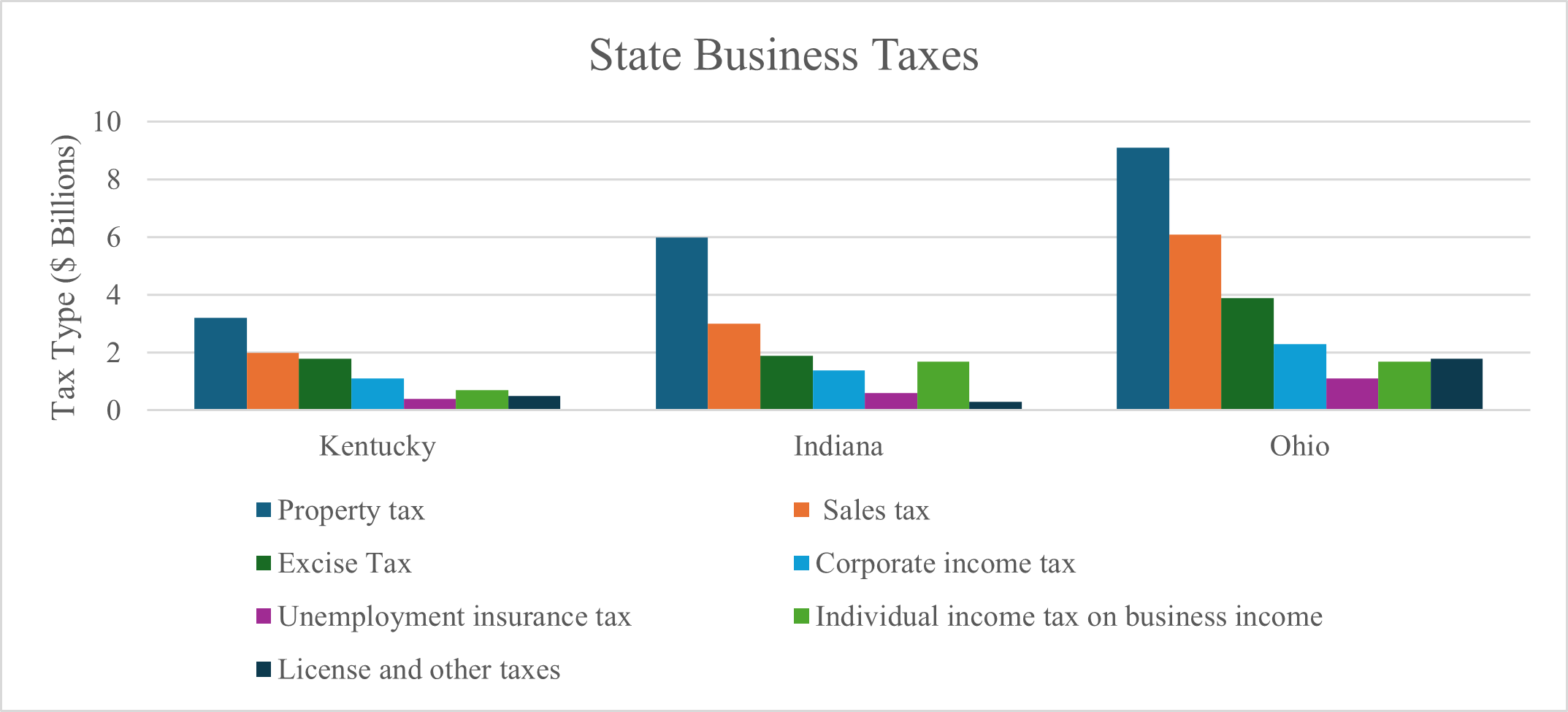
Source: Council of State Taxation
Property taxes have a large impact on commercial development—as the chart above illustrates property taxes are companies largest tax bill. According to the Council on State Taxation, taxes on both real and personal property are the largest source of state and local tax revenue. Complicating matters for companies, in general, property taxes are increasing nationwide, doubling in some markets between 2021 and 2022, according to a recent study from ATTOM Data Solutions, a real estate research firm.
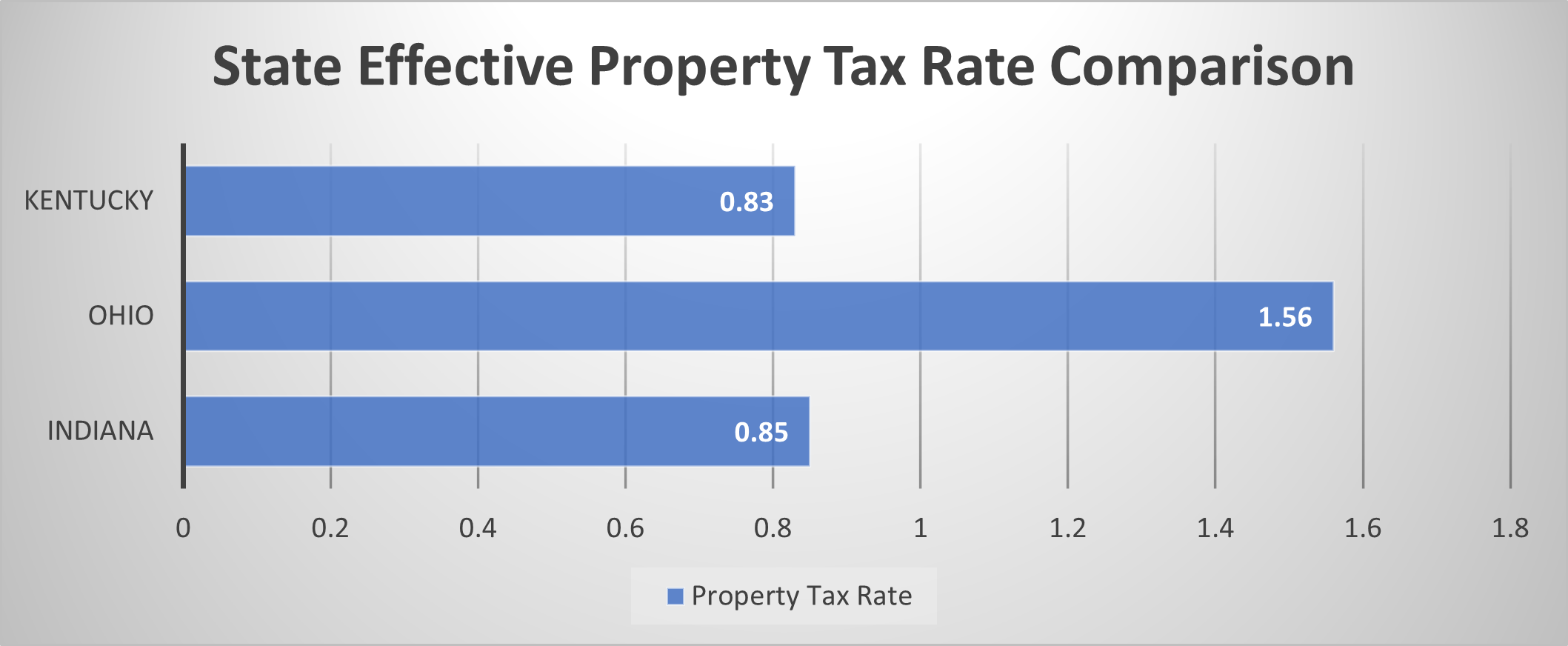
Source: Rocket Mortgage
Ohio is the unfortunate winner when it comes to comparing the state to Indiana and Kentucky for the state’s effective property tax rate. Whether measuring the impact on a state’s ability to recruit companies or keep housing attainable for their current residents, rising property tax rates driven in large part to a lack of housing supply has a major negative impact.