

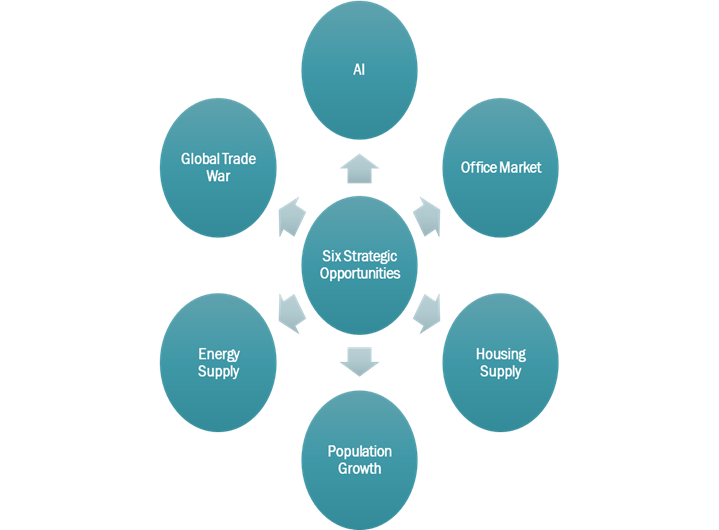
 Communities and companies are faced with massive disruption that creates substantial strategic opportunities. Driven by policy, technology, a changing global economic landscape and worker behavior, how communities and companies deal with issues such as Artificial Intelligence (AI), the collapse of the office market, lack of housing supply, dwindling population growth in rural communities, the lack of energy supply and the global trade war impact the future for these organizations across the globe.
Work from home mixed in with AI is substantially driving down demand for existing, and new office space. Once great Downtowns and suburban developments are struggling with over 20% vacancy rates and they are searching for answers. Older, historic structures may be strong candidates for office conversion into residential developments. Newer office towers with large floor plates will have to focus on new and better tenants as they remain offices. The reality of the office market is new and bigger incentives will be needed to transform an office market challenge into an opportunity.
The lack of housing is another opportunity for communities big and small across the United States. The housing sector has not recovered from the 2008 financial services collapse. Fast growing urban markets in many areas are struggling to keep up with surging residential demand which is driving up the cost of housing and property taxes. Rural communities are desperate for any new residential development as their population decline creates a demographic dilemma for housing developers. No industry in the United States is more heavily regulated than housing development and communities that remove this regulatory burden will like capture the most of the housing opportunity.
Driving population growth is a major economic opportunity for many communities across the United States. Fast growing regions are attractive to new employment opportunities. However, population growth needs to be addressed everywhere. In Ohio, only 14 of the 88 counties are expected to add population by 2050. Many of Ohio’s rural counties may lose over 30% of their population in this timeframe. Rural communities are often home to the world’s industrial base as factories are rarely built in urban centers anymore. Regions that attract population growth have the best chance of keeping and attracting new companies and quality of life investments. New and innovative approaches to growing population will be required.
America faces a 21st Century energy crisis as the rise in demand driven by automation, consumers embracing of e-commerce and the resulting data center development are killing major economic development projects across the United States. Industry cannot locate at a site where they cannot get a commitment for the delivery of electricity. Disinvestment in electric transmission has been occurring since 2003, and policy makers are killing the coal energy right when this energy rich power source is needed the most. States that plan for critical electric transmission and attract new sources of power generation are likely winners in the economic future.
Companies and communities that are winners in a global trade war are positioned for massive economic success. The Trump Administration’s implementation of tariffs on global goods has created near term economic challenges for many companies and resulted in higher consumer prices. However, once strong U.S. global trade partners are unlikely to return to that seat of honor as the U.S. trade deficit has continued to ballon and critical U.S. defense industry related supply chains and products are dominated by foreign adversaries. Companies and communities position to back-shore facilities back to the U.S. will be major economic winters in years to come.
Last but not least, the unleashing of AI with consumers and the business marketplace will drive substantial productivity gains but result in the loss of many traditional white-collar jobs. In the first half of 2025, AI-related capital expenditures contributed 1.1% to GDP growth, outpacing the U.S. consumer as an engine of expansion according to JP Morgan. The Stanford Report argues that AI has contributed over $400 billion to the US economy as of 2024, with projections suggesting a $4.4 trillion impact by 2030, and AI will increase productivity and GDP by 1.5% by 2035, nearly 3% by 2055, and 3.7% by 2075 according to Penn Wharton. However, many occupations college educated workers relied on for a good living may well be gone forever. Companies and communities that harness AI for improved productivity and client services as well as prepare displaced workers to succeed are likely to grow in the coming year.
These six strategic opportunities impact the growth of companies and are critical for communities to understand and plan if they wish to retain and attract high-wage jobs and capital investment.