

The Ohio Department of Development released the much-anticipated guidelines for the Residential Economic Development District Grants (REDD) Program that provides funding for local governments located within twenty miles of a “major economic development project” to support public infrastructure tied to residential development.
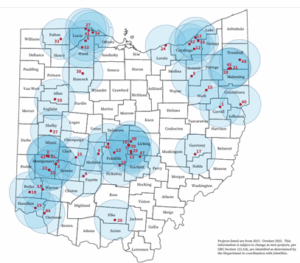 REDDs Basics. The Ohio Department of Development’s REDDs Program guidelines provide important basic information on the program.
- REDDs Program application for FY 2026 will open on December 16, 2025, and be submitted by January 16, 2025.
- Awards range from $250,000 to $2,500,000 for projects with at least one hundred housing units for one hundred families.
- Eligible applicants include a county, township, or municipal corporation that is fully or partially located within 20 miles of a major economic development project creating 700 jobs or have a $700 capital investment constituting 48 sites across the Buckeye State that include energy, logistics and distribution, automative, advanced manufacturing, health care, information technology, military and federal and financial services projects—see the ODOD map.
- Applications can be submitted in tandem with a housing developer, port authority, COG, MPO or multiple local governments.
Pro-Housing Policies are Critical. Local governments seeking a REDDs grant must adopt “pro-housing policies that remove regulatory barriers and reduce development costs by
- increasing the rate at which permits for housing are reviewed,
- expediting the review of permits for a diverse range of housing developers,
- subsidizing or decreasing costs related to water or sewer connections and extensions for major workforce housing projects,
- acquiring or readying sites that are ready to be financed and built upon by developers,
- reducing or eliminating impact, inspections, and plan review fees for housing developers,
- adopting a zoning plan that includes promoting higher density, smaller lot size, and minimum setback requirements,
- developing a comprehensive plan that promotes diverse residential development options,
- having no or minimal parking requirements for developments that include residential units,
- conducting a traffic study,
- improving water or sewer infrastructure,
- improving roads or permitting both rigid and flexible paving types.
- developing partnerships to expand the provision of sewer and water services to new areas, and
- promoting the use of non-traditional building structures such as modular or manufactured homes.
Eligible applicants can help their cause adopting “imminent plans” for pro-housing policies that refers to the timeline associated with approving a pro-housing development policy or a major workforce housing plan that has been officially approved but not yet enacted within a 90-day deadline imposed on receiving the verification of the enaction from the date of the application submission.
Eligible Costs Support Housing Development. Eligible costs for the grants include up to 10% for administrative costs such as salaries and benefits of employees working on the grant, legal, accounting, audit services related to the grant, rent or purchase of office equipment required to administer grant, providing capital for housing development through grants or loans, readying sites for development, providing financial assistance for housing-related infrastructure projects including road improvements and water or sewer connections, and addressing additional service or public safety needs due to increases in population. Ineligible costs for the grants include administrative costs related to application preparation, and costs incurred outside of the executed grant agreement dates.
REDDs Scoring Matrix Matters. Each application will be reviewed based on a scoring metric focused on:
- Number of units per acre, starting with two units per acre,
- Reduce or have smaller lot sizes, starting with an average of 7,500 square feet,
- Reduce or have smaller setback requirements, starting with six feet,
- Reduce or have lesser open space requirements, starting with 25% of gross acreage.
- Lower or eliminate fees for the inspection, plan, impact, or water and sewer tap fee reductions,
- Use both rigid and flexible pavement types,
- Use the grant funds to conduct traffic studies and thoroughfare plans or can demonstrate success in previously completing such studies or plans for a major workforce housing project,
- Use the grant funds to complete sanitary sewer or water extensions as related to a major workforce housing project,
- adopt more pro-housing development policies – both in quantity and impact.
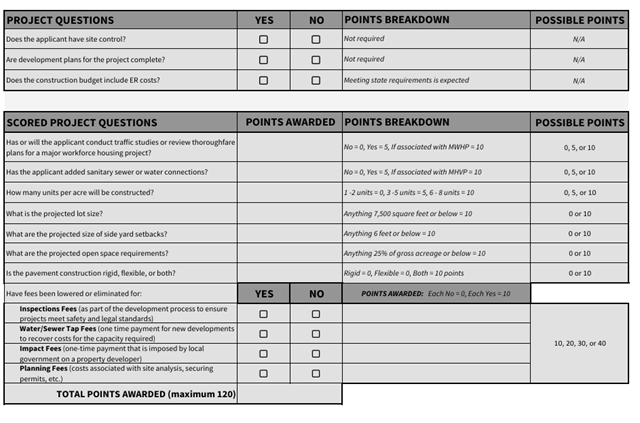
The application rounds will occur every thirty calendar days and, once reviewed and scored, those selected will be announced. This application cycle will continue until all funding has been depleted. Awards will be determined based on the scoring metrics provided in the Application Evaluation Criteria section. Applications may not be modified once submitted.
Tips for Winning REDDs Grants. Communities that are ready for the application with “pro-housing” policies in place for larger single family or multi-family developments are the most likely winners for the Ohio Department of Development REDDs program, and with the large number of counties that have had major economic development projects competition is going to be stiff. Also, while not in the regulations, the Ohio Department of Development will work to spread awards out across the state providing geographic diversity as well as supporting urban, suburban, and rural community projects.